Moroccan Riad Colors: Zellige Tiles, Terracotta & Jewel-Tone Design
· Coloracci Team
Moroccan Riad Colors: Zellige Tiles, Terracotta & Jewel-Tone Design
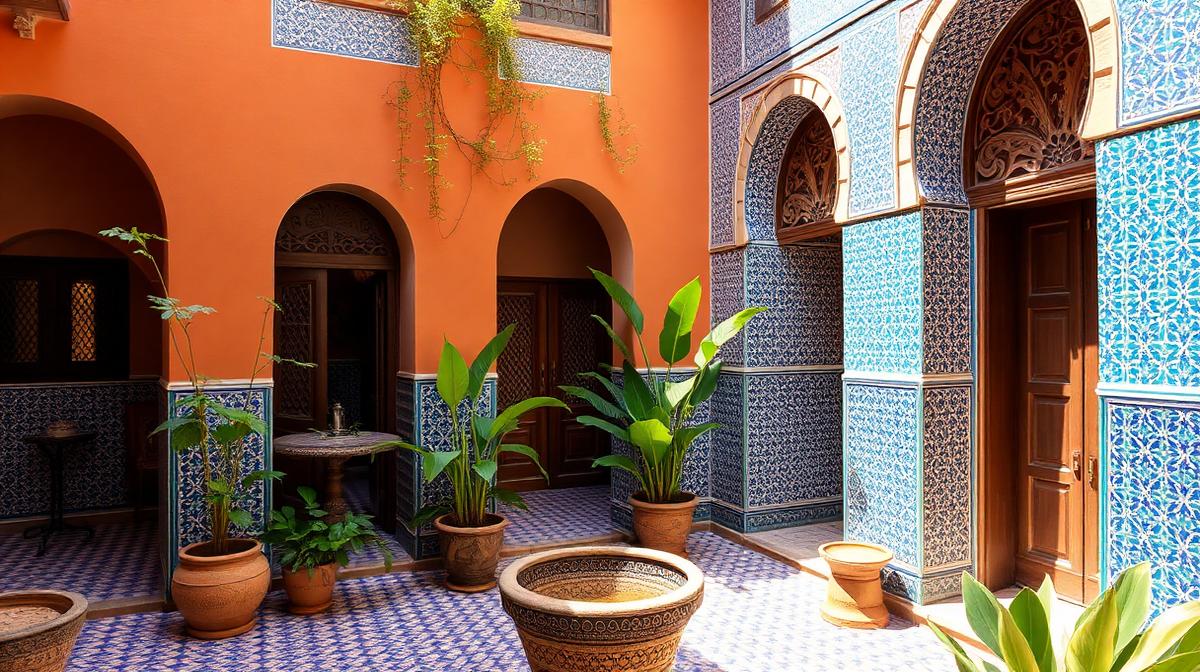
Step through the ornate door of a Moroccan riad and you enter a world where color is both architecture and emotion. The courtyard explodes with cobalt blue tiles, warm terracotta walls glow in the afternoon sun, and intricate zellige mosaics create kaleidoscopic patterns that have captivated designers for centuries.
The Moroccan Color Philosophy
Between Desert and Sea
Morocco's palette is shaped by its geography—the Sahara Desert to the south, the Mediterranean and Atlantic to the north, and the Atlas Mountains in between:
- Terracotta (#C65D3E): The warm red-orange of sun-baked earth and Marrakech's ancient walls
- Cobalt Blue (#0047AB): Chefchaouen's iconic blue walls and the deep Mediterranean sky
- Emerald Green (#006B3C): The sacred color of Islam and the fertile valleys
- Saffron Yellow (#F4C430): Spice markets and desert sunlight
- Sand White (#F5E6CC): Limestone, plaster, and desert dunes
The City Color System
Morocco's historic cities are each defined by a dominant color:
| City | Dominant Color | Hex Code | Meaning |
|---|---|---|---|
| Marrakech | Red/Terracotta | #C65D3E | The "Red City"—protective earth |
| Chefchaouen | Blue | #4A90D9 | Spiritual protection, Jewish tradition |
| Fez | Royal Blue | #002D72 | Imperial heritage, scholarship |
| Essaouira | White & Blue | #E8E0D5 | Atlantic freshness, Portuguese influence |
| Meknes | Green & Gold | #006B3C | Islamic sacred color, imperial power |
Zellige: The Art of Color in Tile
The Zellige Palette
Traditional Moroccan zellige (cut tile mosaic) uses a specific palette developed over centuries:
Core zellige colors:
- Bejmat White (#F0E8D8): Unglazed tile base, warm and organic
- Cobalt Blue (#004B87): The signature color, created with cobalt oxide
- Turquoise (#00A6A0): Copper oxide glazes producing cool blue-greens
- Forest Green (#1B4332): Deep chrome-based greens for borders and accents
- Honey Yellow (#D4A024): Iron oxide producing warm amber tones
- Ox Blood Red (#5C1515): Iron-rich glazes for deep, earthy reds
- Black (#1A1514): Manganese oxide for dramatic contrast
- Saffron (#E8A317): Antimony-based bright yellows
Geometric Color Rules
Zellige patterns follow mathematical principles that dictate color placement:
- No two same-colored tiles share an edge: This creates visual rhythm
- Symmetrical color distribution: Patterns radiate from center points
- Color temperature alternation: Warm and cool colors alternate for visual balance
- Border-field contrast: Darker borders frame lighter central patterns
Riad Architecture Color Zones
The Courtyard Gradient
A traditional riad uses color to create a journey from exterior to interior:
Street door (Bab): Heavy wood (#3E2723) with brass (#B5A642) studs—dark, protective, mysterious Entry passage (Skifa): Dim corridor with dark zellige—transitional, intimate Courtyard (Wust al-Dar): Explosion of color—tiles, planting, sunlight, water Gallery columns: White (#FAEBD7) or cream plaster—framing the courtyard Upper rooms: Painted plaster in jewel tones—private, intimate
The Tadelakt Plaster Palette
Tadelakt (waterproof lime plaster) is unique to Morocco and comes in distinctive colors:
- Natural Tadelakt (#F5E6D0): Warm, honey-toned limestone
- Rose Tadelakt (#C9766E): Pigmented with natural red ochre
- Indigo Tadelakt (#3D5A80): Colored with natural indigo dye
- Olive Tadelakt (#6B705C): Earth-pigmented sage green
The polished, waterproof surface creates a luminous quality that changes with light—similar to the way a well-designed interface uses subtle gradients and shadows.
Textile and Carpet Colors
Berber Carpet Traditions
Moroccan Berber carpets use color systems that vary by region:
Beni Ourain: Cream (#FFF8E7) with charcoal (#36454F) geometric symbols—minimalist, architectural Azilal: Vibrant multicolor on cream—joyful, narrative Boucherouite: Recycled textile strips in electric colors—resourceful, pop art-like Kilim (Hanbel): Flat-weave in red (#A0271D), orange (#D4621C), and black (#1C1C1C)—bold, graphic
Moroccan Leather (Tanneries)
The famous tanneries of Fez produce leather in distinctive colors:
- Natural tan (#D2B48C): Untreated leather
- Saffron yellow (#DFC027): Colored with saffron or pomegranate
- Poppy red (#CC2936): Dyed with poppy flowers
- Mint green (#3EB489): Colored with mint extracts
- Indigo blue (#234B6E): Dyed with indigo plant
Moroccan Color in Food and Spice
The Spice Market Palette
Moroccan cuisine's visual palette directly influences design:
- Saffron (#F4C430): The world's most expensive spice, adding golden warmth
- Cumin (#8B6914): Warm, earthy brown-gold
- Paprika (#CC3333): Vibrant red for visual heat
- Cinnamon (#D2691E): Rich red-brown warmth
- Turmeric (#E8B004): Bright golden yellow
- Mint (#3EB489): Fresh, cool green contrast
This palette of warm spice tones with cool mint accent is one of the most naturally harmonious color systems in the world—and one that designers can directly apply.
Modern Moroccan-Inspired Design
Interior Design Applications
Bohemian maximalist: Layer multiple Moroccan patterns using complementary zellige colors Mediterranean modern: Use terracotta (#C65D3E) + white (#FAFAF5) + cobalt blue (#004B87) Desert minimal: Sand (#E8D5B7) + brass (#B5A642) + charcoal (#36454F)
Digital Design Translation
E-commerce for artisan goods: Warm terracotta backgrounds with cobalt blue CTAs and gold (#C9A64C) accents Travel and hospitality: Rich jewel tones layered over warm neutrals Wellness brands: Tadelakt-inspired soft pinks and creams with sage green accents
The 60-30-10 Moroccan Rule
Apply Moroccan color principles to modern design:
- 60% Warm neutral: Terracotta, sand, or cream as the dominant base
- 30% Jewel accent: Cobalt blue, emerald green, or deep red as secondary
- 10% Metallic spark: Gold, brass, or copper for highlights and CTAs
Creating Moroccan-Inspired Palettes
Use Coloracci's image color extractor to pull colors from photographs of Moroccan architecture, then refine them with our AI palette generator for your specific design context.
Explore more design inspiration: Mediterranean Coastal Colors, Middle Eastern Colors, Persian & Iranian Colors, or African Color Traditions.