The True Colors of Space: From Planet Palettes to Star Science
· Lion Dada
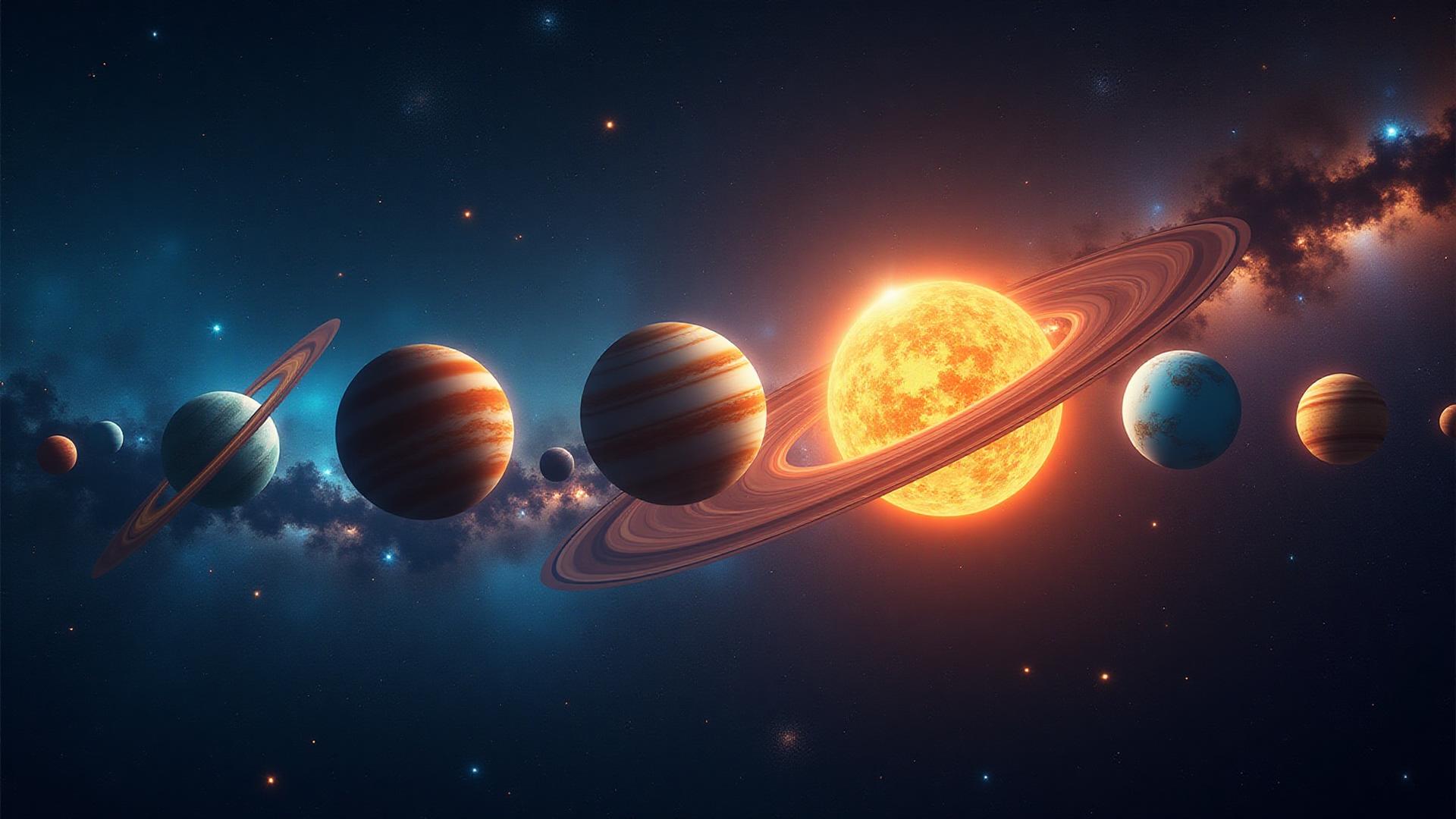
I still remember the first time I realized the night sky was lying to me.
I was eight years old, camping with my father in the Negev desert, far from any city lights. The stars were impossibly bright—thousands of them scattered across the darkness like spilled diamonds. My father pointed at a particularly bright one and said, "That's Betelgeuse. It's actually red, not white."
I squinted harder, trying to see red. All I saw was white, maybe with a tiny orange tinge if I really tried. But when I grew up and started studying color theory, I discovered something that would have blown my eight-year-old mind: our eyes can barely perceive true star colors, and most of the "space photos" we see have been processed to reveal colors invisible to humans. The universe is far more colorful than we can naturally see.
This article is my love letter to cosmic colors—the real science behind why planets look the way they do, why twinkling stars change colors, and why the universe's "average color" isn't black at all, but a shade of beige that scientists actually named "Cosmic Latte."

The True Colors of Our Planets
Let's start with our cosmic neighborhood. If you've seen images of the planets, you might think you know what they look like. But the colors we see depend heavily on how we're looking—human eyes, cameras, or specialized instruments that reveal hidden wavelengths.
Mercury: The Gray Ghost (#8C8C8C)
Mercury looks almost lunar—a gray, cratered world that absorbs most light falling on it. Its surface is covered in iron-poor silicate rocks, giving it that neutral, battleship-gray appearance. There's no atmosphere to add color, no clouds, no weather—just ancient rock battered by billions of years of meteor impacts.
What fascinates me about Mercury's gray is how it represents the absence of color stories. Unlike Earth with its vibrant blues and greens, Mercury has nothing to tell us about atmosphere or life. It's the baseline—what a world looks like when stripped of everything that makes other planets colorful.
Venus: Sulfuric Yellow (#E6C35C)
Venus appears as a pale yellowish-white orb, but that color comes entirely from its clouds, not its surface. The planet is wrapped in thick clouds of sulfuric acid that reflect about 70% of sunlight, making Venus the brightest planet in our sky.
If you could somehow see through those clouds, Venus's surface would glow an eerie red-orange from the intense heat (over 460°C). The yellow tones we associate with Venus come from sulfur compounds in its atmosphere—a reminder that planetary colors often tell stories of chemistry rather than geology.
Earth: The Blue Marble (#4A90D9)
Our home planet's nickname "Blue Marble" comes from the famous photograph taken by Apollo 17 astronauts in 1972. That blue comes from our oceans absorbing red, orange, and yellow light while reflecting blue and green wavelengths back into space.
But Earth's color changes depending on where you look. Ocean blue, desert tan, forest green, polar white, cloud patterns—our planet is essentially a color wheel from space. When astronauts describe looking at Earth from orbit, they often mention how the colors seem more vivid than any photograph can capture.
Mars: The Rust Red Planet (#CD5C5C)
Mars's famous red color is literally rust. The planet's surface is covered in iron oxide—the same chemical compound that makes blood red and gives rust its color. Billions of years ago, iron in Martian rocks reacted with oxygen (possibly from water breaking apart) to create this planet-wide coating of rust.
The connection between Mars and red in human psychology is fascinating. We named the planet after the Roman god of war because of its blood-red appearance. Every time a brand uses red to convey passion or urgency, they're unconsciously channeling the same associations that ancient astronomers made when they looked up at Mars.
Jupiter: Orange Bands (#D4A574)
Jupiter's famous bands are created by ammonia crystals, sulfur compounds, and organic molecules swirling in its upper atmosphere. The lighter zones are higher altitude clouds of ammonia ice. The darker belts contain sulfur and phosphorus compounds that absorb more light.
The Great Red Spot—Jupiter's famous storm system—gets its color from complex organic molecules created when sunlight breaks down chemicals in the upper atmosphere. It's essentially a giant orange-red hurricane that has been raging for at least 400 years.
Saturn: Golden Yellow (#E8D5A3)
Saturn appears golden-yellow because its upper atmosphere contains ammonia crystals that absorb blue light and reflect yellow-gold wavelengths. The planet's iconic rings are mostly water ice, which is why they appear bright white in contrast to the planet itself.
What strikes me about Saturn's palette is how it embodies luxury and elegance—golden tones paired with icy whites. If Saturn were a brand, it would be selling watches or champagne.
Uranus & Neptune: The Blue Giants
Uranus (#72CDD5) and Neptune (#3D5A99) both appear blue, but for the same reason—methane in their atmospheres absorbs red light and reflects blue. Neptune is a deeper blue because its atmosphere contains additional compounds that absorb red light more efficiently.
Interestingly, recent research suggests Uranus might actually be more green-blue than we thought, and some of our color perceptions were influenced by how images were processed in the 1980s when Voyager flew by.

Why Stars Are Different Colors (And Why It's Counterintuitive)
Here's something that confused me for years: hot things are supposed to be red, right? Fire, heating elements, lava—they all glow red when hot. But in space, the hottest stars are blue, and the coolest visible stars are red.
This seems backwards, but it makes perfect sense once you understand blackbody radiation.
The OBAFGKM Classification
Astronomers classify stars by temperature using the letters O, B, A, F, G, K, M (traditionally remembered by the mnemonic "Oh Be A Fine Girl/Guy, Kiss Me"). This sequence runs from hottest to coolest:
O-type stars (#9BB0FF): Blue giants burning at 30,000-50,000 Kelvin. These massive, short-lived stars emit most of their light in ultraviolet wavelengths. Zeta Ophiuchi is a famous example.
B-type stars (#AABFFF): Blue-white stars at 10,000-30,000K. Rigel, the bright star in Orion's foot, is a blue supergiant that's 120,000 times brighter than our Sun.
A-type stars (#CAD7FF): White stars around 7,500-10,000K. Sirius, the brightest star in our night sky, is a white A-type star.
F-type stars (#F8F7FF): Yellow-white stars at 6,000-7,500K. Procyon is a nearby F-type star.
G-type stars (#FFF4EA): Yellow stars like our Sun, burning at 5,200-6,000K. This is why sunlight appears white-yellow.
K-type stars (#FFD2A1): Orange stars at 3,700-5,200K. Arcturus, the fourth-brightest star in the sky, is an orange giant.
M-type stars (#FFCC6F): Red dwarfs and red giants at 2,400-3,700K. Betelgeuse, the red supergiant my father pointed out, is an M-type star nearing the end of its life.
Why Hot = Blue and Cool = Red in Space
The key is understanding that stars emit light across all wavelengths, but the peak emission depends on temperature. Very hot objects emit most strongly in blue/ultraviolet wavelengths. Cooler objects peak in red/infrared.
Our Sun's surface temperature (about 5,500K) puts its peak emission right in the green part of the spectrum—but because it emits so broadly across all visible wavelengths, we perceive sunlight as white or yellow.
This is why color temperature in design uses Kelvin measurements. When designers talk about "warm" 2700K lighting versus "cool" 6500K lighting, they're using the same physics that determines star colors.
Why Stars Twinkle (And Change Colors)
That twinkling you see? It's not the stars themselves—it's Earth's atmosphere acting like a chaotic lens. As starlight passes through different layers of air at different temperatures and densities, the light gets bent, causing the star to appear to jump around slightly. This also causes momentary color shifts as different wavelengths are bent differently.
Stars near the horizon twinkle more because their light passes through more atmosphere. Planets don't twinkle as much because they're close enough to appear as tiny disks rather than points, which averages out the atmospheric distortion.

The Chemistry of Nebula Colors
Nebulae—those stunning cosmic clouds of gas and dust—produce some of the most vibrant colors in the universe. But here's the thing: we can't see most of these colors with our naked eyes, even through powerful telescopes.
Emission Nebulae: Glowing Gas
When hot, young stars bathe nearby gas clouds in ultraviolet radiation, the atoms get excited and emit light at very specific wavelengths. Each element has its signature colors:
Hydrogen Alpha (Hα) (#FF6B6B): The most common emission, producing deep red at 656 nanometers. This is why so many nebula images feature red prominently.
Hydrogen Beta (Hβ) (#4ECDC4): A cyan-blue emission at 486 nanometers, often seen in conjunction with Hα.
Oxygen III (OIII) (#2ECC71): Produces a distinctive teal-green at 496-501 nanometers. The Ring Nebula and Orion Nebula show this color prominently.
Sulfur II (SII) (#E74C3C): Deep red at 672 nanometers, often mapped to red in the famous "Hubble Palette."
Nitrogen II (NII) (#E67E22): Red-orange emission at 658 nanometers.
Helium I (HeI) (#F1C40F): Yellow emission at 587 nanometers.
The Hubble Palette: Seeing the Invisible
Many of the most famous space images use what's called the "Hubble Palette" or "SHO palette"—mapping Sulfur to Red, Hydrogen to Green, and Oxygen to Blue. This creates false-color images that reveal details our eyes could never see directly.
The iconic "Pillars of Creation" image? Those colors are processed this way. The pillars would appear mostly red to our eyes (from hydrogen emission), but by assigning different colors to different elements, astronomers create images that communicate vastly more information.
This connects to something fundamental about how we use color in design: color can be informational, not just aesthetic. NASA's false-color images use the same principle that data visualizations and accessibility-focused designs employ—color as a tool for understanding.
Reflection Nebulae: Scattered Blue
Unlike emission nebulae, reflection nebulae don't produce their own light—they reflect light from nearby stars. These typically appear blue for the same reason our sky is blue: smaller wavelengths (blue light) scatter more efficiently than larger wavelengths (red light). This is called Rayleigh scattering.
The Pleiades star cluster is surrounded by beautiful blue reflection nebulae, created by the cluster's hot stars illuminating nearby dust clouds.

Galaxy Colors Tell Stories of Stellar Ages
When you look at a galaxy, you're seeing the combined light of billions of stars. The overall color tells you about the galaxy's stellar population—essentially, its age and activity level.
Blue Spiral Galaxies: Young and Active
Spiral galaxies like our Milky Way often show blue arms because they contain lots of young, hot, blue stars being born in their spiral arms. Star formation regions produce blue light from massive O and B-type stars (which burn fast and die young).
The psychology of blue as representing trust, stability, and depth takes on cosmic significance when you realize blue galaxies are the vibrant, active, star-forming ones—cosmic youth in action.
Red Elliptical Galaxies: Old and Quiet
Elliptical galaxies appear reddish because they've used up most of their star-forming gas. What remains are older, cooler stars—the red and orange K and M-type stars that burn slowly for billions of years. These galaxies are essentially "retired," no longer producing new stars.
Galaxy Redshift: The Universe's Color Shift
Here's something mind-bending: the color of distant galaxies also tells us how fast they're moving away from us. Due to the expansion of the universe, light from distant galaxies gets stretched toward red wavelengths (redshift). The farther away a galaxy, the more redshifted its light becomes.
This is how we know the universe is expanding—Edwin Hubble observed that nearly all galaxies show redshift, and more distant ones show more redshift. Color, in this case, becomes a cosmic speedometer.

Earth's Colors: What Makes Our Planet Special
Seen from space, Earth is a riot of color compared to its neighbors. But each color tells a story about what makes our planet unique.
Ocean Blue (#4A90D9)
Water appears blue because it absorbs red wavelengths and reflects blue. Our oceans cover 71% of Earth's surface, making blue our planet's dominant color from space. No other planet in our solar system has liquid water on its surface—this blue is genuinely unique.
Land Greens and Browns
Chlorophyll in plants absorbs red and blue light for photosynthesis, reflecting green. From space, the Amazon rainforest appears as deep green, while deserts show tan and brown from exposed minerals. The seasonal color changes visible from orbit—spring greening, autumn browning—are unlike anything else in our solar system.
Cloud White
Water vapor clouds reflecting all wavelengths equally appear white against both blue oceans and green land. These ever-changing cloud patterns are signatures of an active, dynamic atmosphere.
The "Cosmic Latte" of the Universe
Here's a delightful fact: astronomers calculated the average color of the universe by analyzing the light from over 200,000 galaxies. The result? A slightly beige white color they named "Cosmic Latte" (#FFF8E7).
The universe isn't black—it's beige. Black is simply where we're not seeing the countless distant stars and galaxies that contribute to this cosmic average.

Why Is Space Black? (It Shouldn't Be)
This might be the most profound color question in astronomy: if there are stars in every direction, why isn't the night sky bright?
This puzzle, known as Olbers' Paradox, has a fascinating answer that connects to the nature of the universe itself.
The Expanding Universe Solution
The universe is finite in age (about 13.8 billion years old), and light travels at a finite speed. This means we can only see stars whose light has had time to reach us. Beyond a certain distance, the universe is essentially invisible to us.
Additionally, the universe is expanding. Light from the most distant objects gets stretched into infrared and microwave wavelengths we can't see. The cosmic microwave background radiation—the oldest light in the universe—has been stretched so much it's now invisible microwaves rather than visible light.
What We Actually See
When you look at the night sky, you're seeing:
- Nearby stars as points of light
- The Milky Way's glow from distant stars
- A few nearby galaxies (Andromeda is visible as a faint smudge)
- Black regions that are actually filled with objects too faint or too distant to see
Space appears black not because nothing is there, but because the light from most of the universe either hasn't reached us yet, has been stretched beyond visibility, or is simply too faint for our eyes to detect.
How NASA "Colors" Space Photos
Most space images you see have been processed—but that doesn't mean they're fake. Understanding how NASA creates these images helps appreciate what they reveal.
True Color vs. Enhanced Color
True color images combine red, green, and blue filter data to approximate what human eyes would see. These are relatively rare because space objects are often faint, and our eyes have poor color perception in low light.
Enhanced color images stretch or adjust colors to reveal subtle details. Mars images often enhance the contrast between different rock types, making geological features more visible.
False color images assign arbitrary colors to different wavelengths, often including invisible wavelengths like infrared or ultraviolet. The famous "Pillars of Creation" uses this technique.
Why Process Images At All?
Our eyes evolved to function on Earth's surface under sunlight. Space cameras can detect wavelengths we can't see, observe much fainter objects than our eyes, and capture details over long exposures impossible for biological vision.
Processing space images is like adjusting contrast and saturation in design tools—it reveals information that was always there but wasn't immediately visible.
Designing with Cosmic Inspiration
Space colors offer a unique palette for designers willing to think beyond terrestrial references. Here's how to bring cosmic color theory into your work:
Planet-Inspired Palettes
Each planet suggests a different mood:
- Mercury gray (#8C8C8C): Minimal, professional, timeless
- Venus yellow (#E6C35C): Mysterious, warm, atmospheric
- Earth blue (#4A90D9): Trustworthy, vital, environmental
- Mars red (#CD5C5C): Bold, pioneering, adventurous
- Jupiter orange (#D4A574): Warm, powerful, dynamic
- Saturn gold (#E8D5A3): Luxurious, elegant, classic
- Uranus cyan (#72CDD5): Cool, unique, innovative
- Neptune blue (#3D5A99): Deep, mysterious, professional
Nebula Color Schemes
Nebula palettes work beautifully for creative and tech brands:
- Hydrogen red + Oxygen teal creates vibrant, energetic combinations
- The Hubble Palette (red/green/blue from SII/Hα/OIII) provides scientifically-grounded false color schemes
- Reflection nebula blues suggest ethereal, dreamlike qualities
Star Temperature Gradients
The OBAFGKM sequence creates a natural gradient from cool blue (#9BB0FF) through white (#F8F7FF) to warm orange (#FFCC6F). This progression works for:
- Temperature or intensity indicators
- Progress bars and status displays
- Energy or heat visualizations
- Scientific or educational interfaces
Try our AI Website Designer to generate cosmic-inspired color palettes, or use the Mood Board Generator to explore space-themed design directions.
Conclusion: The Universe's Color Story
Looking up at the night sky, we see only a fraction of the universe's true colors. The twinkling stars are showing us their temperatures. The planets display their chemical compositions. The nebulae reveal atomic emissions we've learned to translate into visible rainbows. Even the blackness of space tells a story about the age and expansion of the universe itself.
Color in space isn't just aesthetic—it's information. Every hue encodes chemistry, temperature, distance, and motion. Learning to read these colors is like learning a universal language written in light itself.
The next time you look up at the stars, remember: that white point of light might be a blue-hot giant or a dying red supergiant. That rusty dot is literally a planet covered in rust. That dark patch between stars isn't empty—it's filled with wonders we've only begun to photograph and process into colors we can see.
The universe is painting masterpieces all around us. We just needed science to teach our eyes how to see them.
Explore more about color theory and its applications with our complete guide to color harmony, or discover how complementary colors work using principles that apply from galaxies to graphic design.