National Flag Colors: The Complete Meaning, Symbolism & Hex Code Guide
· Coloracci Editorial
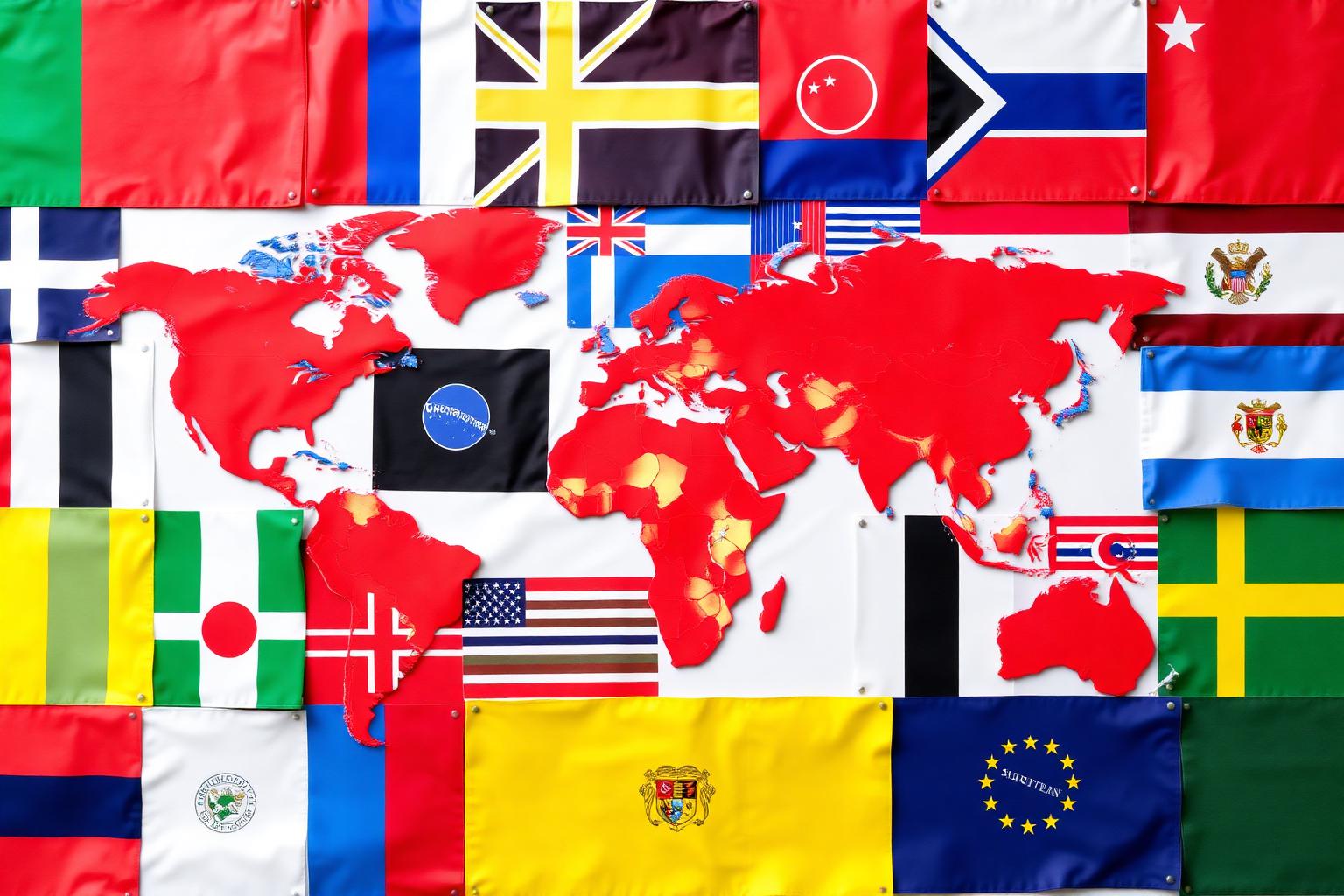
National flag colors are the most concentrated form of color communication on the planet. Every hue on a flag has been argued over, voted on, and ratified — sometimes in blood — to signal exactly what a nation wants the world to feel when its banner unfurls. For designers, brand strategists, and color enthusiasts, flags are a 200-year masterclass in semantic color: a few pigments doing the work of an entire identity system.
This guide breaks down the meaning, hex codes, and psychological weight of every dominant flag color, the regional palettes they cluster into, and the practical takeaways you can lift into your next palette. If you enjoy the intersection of color and identity, you'll also want to read our deep dives on military uniform colors and superhero color psychology — both build on the same semiotic logic flags pioneered.
Why National Flag Colors Matter
A flag has to do three impossible things at once: be visible from a kilometre away, be reducible to a fingernail-sized favicon, and carry generations of cultural meaning. The only design tool flexible enough to do all three is color.
That's why flag committees obsess over Pantone references, why nations have been to court over a shade of blue, and why the world's most successful brands — from Coca-Cola to YouTube — quietly borrow the same color logic flags codified two centuries ago: pick few colors, pick saturated ones, and make every hue mean something.
The Complete National Flag Color Breakdown
Below are the six dominant colors that account for over 95% of the world's national flags, with representative hex codes, the named color, and the psychological territory each one owns.
Red — Courage, Revolution, Sacrifice
- Hex:
#CE1126(Pan-Arab Red),#DA121A(Pan-African Red),#BF0A30(US Old Glory Red) - Color name: Crimson, Scarlet, Vermilion
- Used by: ~74% of national flags — China, Vietnam, Turkey, Japan, USA, UK, France, Canada, Morocco
- Psychology: Red is physiologically arousing — it raises heart rate and dilates pupils. On flags it almost always points to blood spilled for independence, revolutionary energy, or warrior courage. It's the loudest possible color a flag can shout.
Blue — Justice, Loyalty, Freedom, Peace
- Hex:
#002868(US Old Glory Blue),#012169(UK Navy),#003DA5(EU Reflex Blue) - Color name: Navy, Royal Blue, Cerulean
- Used by: ~50% of national flags — USA, France, UK, Argentina, Greece, Israel, Australia
- Psychology: Blue is the color of distance — sky, ocean, horizon. Nations use it to signal the rule of law, democratic ideals, and maritime heritage. It's calm and authoritative, which is exactly the emotional posture a young republic wants to project.
Green — Hope, Renewal, Spirituality
- Hex:
#009639(Pakistan Green),#006B3F(Cadmium Green),#028A0F(Islamic Green) - Color name: Emerald, Forest, Islamic Green
- Used by: ~39% of national flags — Saudi Arabia, Pakistan, Brazil, Mexico, Italy, Ireland, Nigeria
- Psychology: Green is the most culturally specific of the major flag colors. In the Islamic world it represents paradise and the Prophet; in the Americas it codes fertile land and natural wealth; in Ireland it stakes a claim to Catholic identity. Always check the cultural context before borrowing it.
Yellow / Gold — Wealth, Sun, Royal Legacy
- Hex:
#FFD100(Pan-African Gold),#FFC72C(Vatican Gold),#FCD116(Colombian Yellow) - Color name: Gold, Saffron, Amber
- Used by: ~35% of national flags — Spain, Germany, Brazil, Colombia, Vatican, Ghana, Vietnam
- Psychology: Gold is the color of resources and monarchy. African and South American flags use it to symbolize mineral wealth and sunlight; European flags use it to invoke royal continuity and imperial legacy. It's the only color that simultaneously reads as "the people's wealth" and "the crown's wealth."
White — Purity, Unity, Peace
- Hex:
#FFFFFF - Color name: White, Pure White
- Used by: ~71% of national flags — Japan, France, USA, UK, Canada, Argentina, Israel
- Psychology: White is the most generous color a flag can carry. It signals truce, moral clarity, and the neutral ground that binds the other colors together. Its presence usually says "the nation aspires to peace" — even when the flag's other colors say "the nation will fight for it."
Black — Resistance, Mourning, Strength
- Hex:
#000000 - Color name: Jet Black, Sable
- Used by: ~22% of national flags — Egypt, South Africa, Germany, Kenya, Jamaica, UAE
- Psychology: Black is the heaviest hue in the flag vocabulary. Pan-African and Pan-Arab traditions use it to signal resistance to colonial rule and the strength of the people. In a flag, black almost never means decoration — it means memory.
Purple — The Color You Almost Never See
- Hex:
#6B3FA0 - Color name: Royal Purple, Tyrian Purple
- Used by: Just two national flags — Dominica (a Sisserou parrot) and Nicaragua (a rainbow). That's it.
- Why: Pre-1856 purple dye came from sea snails and cost more than gold. By the time synthetic purple was cheap enough to mass-produce, the world's major flags were already designed. Purple's absence is the single best example of how economics shaped visual culture.
Patterns & Analysis: What the Color Choices Reveal
Look at the global flag corpus as a single dataset and three patterns leap out.
1. The Tricolor Is the World's Default
The single most common flag format on Earth is three horizontal or vertical bands of color. The French Revolution popularized the format; independence movements from Italy to Romania to Ireland to Mexico to Ivory Coast inherited it. The tricolor is popular because it's the minimum viable composition that still feels balanced, asymmetric, and meaning-rich.
2. Colors Travel in Regional Packs
Flag color isn't randomly distributed — it clusters geographically and politically.
- Pan-African (red, gold, green): Inherited from Ethiopia, one of the only African nations never colonized. Worn by Ghana, Senegal, Mali, Cameroon, and dozens more.
- Pan-Arab (red, white, black, green): Traces back to the 1916 Arab Revolt. Worn by Egypt, Jordan, UAE, Kuwait, Iraq, Syria.
- Pan-Slavic (red, white, blue): Codified at the 1848 Prague Slavic Congress. Worn by Russia, Serbia, Slovakia, Slovenia, Croatia.
- Nordic (white cross on a saturated field): Denmark, Sweden, Norway, Finland, Iceland — a 1,000-year-old Christian-maritime visual dialect.
When you see a flag, you can usually guess the continent before you can name the country. That's color doing identity work at planetary scale.
3. Red, White, Blue Wins the Popularity Contest
Combine the top three colors and you get the most common national palette on Earth — used by the USA, France, UK, Russia, Australia, Thailand, the Netherlands, Cuba, North Korea, Iceland, Chile, and dozens more. The combination wins because it pairs maximum contrast (red and blue at opposite ends of the warm/cool axis) with a neutral white resting field between them.
The Color Psychology of National Flags
Strip the geopolitics away and a national flag is doing one job: setting the emotional thermostat for an entire nation. Here's the rough emotional grammar flags speak:
- Warm hues (red, orange, yellow) broadcast energy, sacrifice, and identity-pride. Nations that fought hard for independence almost always foreground a warm hue.
- Cool hues (blue, green) broadcast institutional legitimacy and natural belonging. Older republics and resource-rich nations lean cool.
- Neutrals (white, black) anchor the emotional weight. White lifts the palette toward peace; black grounds it in memory and resistance.
- Metallic suggestion (gold) layers on prestige and continuity. A nation with gold on its flag is saying "we have history and resources."
This same warm/cool/neutral/metallic grammar is exactly what works in modern brand systems — which is why a YouTube red, a Facebook blue, or a Coca-Cola red+white system feels so primal. They're speaking flag-language.
Designer Takeaways: Applying Flag Color Theory
Five lessons you can lift directly from flags into your next palette, brand system, or product UI.
1. Cap Your Palette at Three or Four Colors
Almost every national flag uses 2–4 hues. The constraint isn't aesthetic — it's cognitive. Humans struggle to hold more than four colors in working memory. Strong brand systems honor the same limit.
2. Give Every Color a Job
On a flag, no color is decorative. Apply the same test to your palette: if you can't name the meaning, role, or contrast relationship of a color in one sentence, it doesn't belong in the system.
3. Pair High-Contrast Hues With a Neutral Resting Field
Red and blue are an electric pair, but the reason the tricolor works is the white in the middle. When you're combining two saturated brand colors, always reserve a third neutral (white, black, or off-white) to give the eye somewhere to rest.
4. Saturate Your Brand Colors at Flag Strength
Flag colors are almost never muted. They're full-saturation because they need to read from a distance, on cheap fabric, in bad light. Modern brands designed for tiny app icons and noisy feeds have the exact same constraint — and increasingly the exact same solution.
5. Treat Cultural Color Meaning as a Hard Constraint
Green means renewal in the West and paradise in the Islamic world. Red means luck in China and danger in a Western dashboard. Before you ship a global product, do the same cultural audit a flag committee does. Our pieces on military uniform color symbolism and superhero color psychology explore exactly how this cultural layer shifts meaning across audiences.
Data Table: Flag Colors at a Glance
| Color | Primary Hex | Color Name | Psychological Meaning |
|---|---|---|---|
| Red | #CE1126 |
Crimson / Pan-Arab Red | Courage, revolution, sacrifice |
| Blue | #002868 |
Old Glory Blue / Navy | Justice, loyalty, freedom, peace |
| Green | #009639 |
Islamic / Emerald Green | Hope, renewal, spirituality, paradise |
| Yellow / Gold | #FFD100 |
Pan-African Gold | Wealth, sun, royal legacy |
| White | #FFFFFF |
Pure White | Purity, unity, peace, neutrality |
| Black | #000000 |
Jet Black | Resistance, mourning, strength |
| Orange | #FF6600 |
Saffron | Courage, sacrifice (esp. Hinduism) |
| Purple | #6B3FA0 |
Royal / Tyrian Purple | Royalty, rarity (only 2 flags) |
Build a Palette With the Same Power as a Flag
National flags prove that a few well-chosen colors, anchored in meaning and tuned for contrast, can carry an entire identity for centuries. The same logic powers every great brand palette.
Use the Coloracci AI palette generator at coloracci.ai to build a flag-grade color system for your brand, product, or design project. Feed it any seed color — a national hue, a heritage shade, a moodboard pull — and the Fibonacci-tuned engine returns a mathematically balanced, semantically coherent palette in seconds.
If your work touches identity, defense, or sport branding, pair this guide with our companion deep-dives on military uniform color psychology and superhero color psychology for a complete view of how color carries meaning at scale.
Sources: Jootoor Flag Color Database, Spectralore National Flag Colors archive, Flag of the World (FOTW) Statistics, 2026.