The History of Color: From Cave Walls to Digital Screens
· Lion Dada
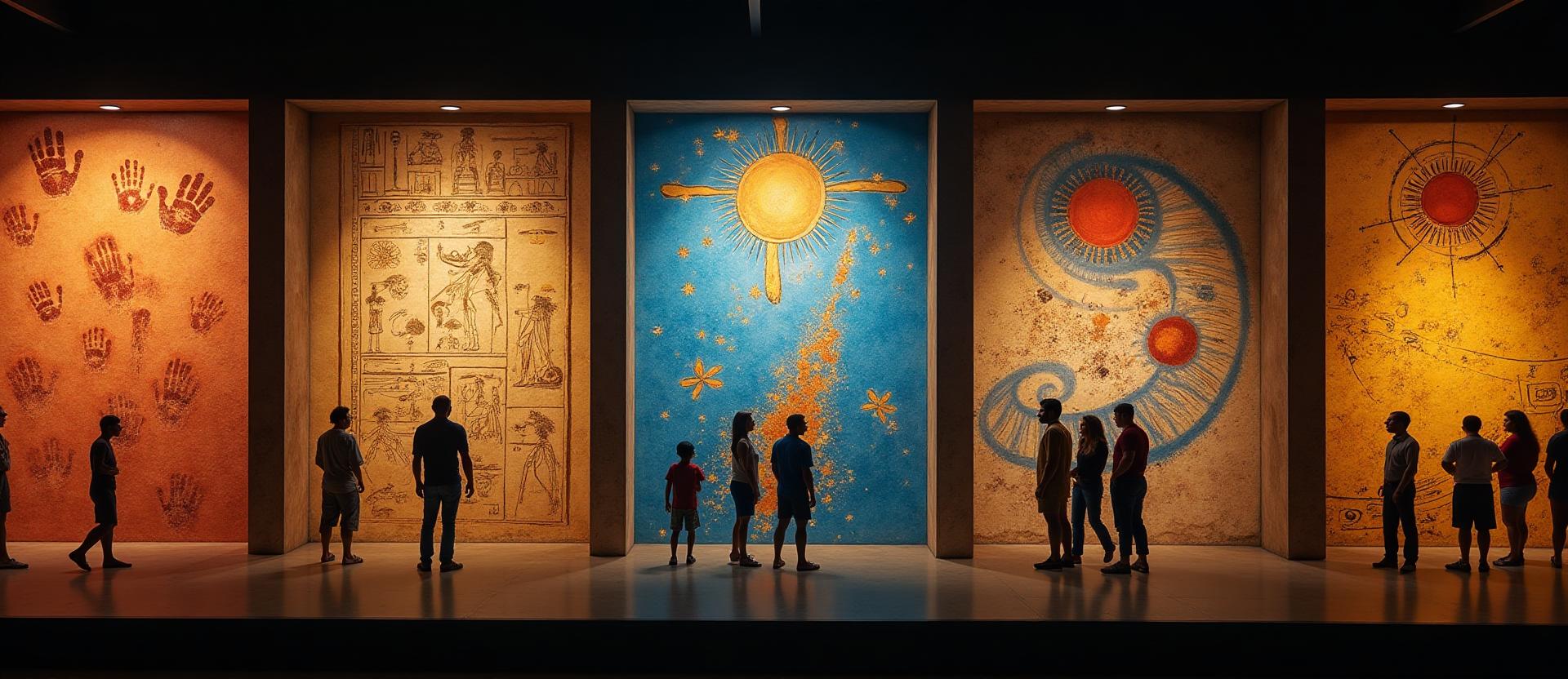
The History of Color: From Cave Walls to Digital Screens
Color surrounds us. It influences our emotions, shapes our decisions, and defines our cultures. Yet the story of how humanity learned to see, create, and manipulate color is one of the most fascinating narratives in human history—a tale spanning tens of thousands of years, connecting ancient cave painters with today's digital designers.
The Dawn of Pigment
Long before written language, our ancestors were artists. In the caves of Lascaux, France, and Altamira, Spain, prehistoric humans created stunning paintings using a limited but powerful palette. These early artists worked with what nature provided: ochres for reds and yellows, charcoal for blacks, and minerals like manganese for deeper browns.
The creation of these pigments was labor-intensive. Red ochre, one of the earliest pigments, required mining iron-rich rocks, grinding them into fine powder, and mixing them with animal fat or plant oils. The result was a stable, lasting color that has survived for over 30,000 years on cave walls. These weren't random choices—archaeological evidence suggests our ancestors traveled considerable distances to obtain high-quality pigments, indicating that color held significance beyond mere decoration.
Egypt's Color Revolution
The ancient Egyptians revolutionized color technology. They didn't just use what nature provided; they invented new colors entirely. Around 2500 BCE, Egyptian chemists created Egyptian Blue, the world's first synthetic pigment. By heating limestone, sand, and copper-containing minerals to temperatures between 800-900°C, they produced a vivid blue that adorned temples, tombs, and papyri.
This wasn't their only innovation. Egyptians developed sophisticated techniques for creating greens, using malachite and verdigris. They perfected the use of cinnabar for brilliant reds and created a stable black from carbon. Their color palette was so advanced and vibrant that many Egyptian artworks retain their brilliance today, thousands of years later.
But Egyptian color was more than aesthetic—it was symbolic. Gold represented the eternal and divine. Green symbolized regeneration and life. Black, contrary to modern associations with death, represented fertility and the life-giving Nile silt. White denoted purity and sacredness. This symbolic use of color would influence cultures worldwide for millennia to come.
The Purple Problem
Perhaps no color better illustrates the historical value of pigments than Tyrian purple. Extracted from sea snails found in the Mediterranean, this deep purple dye required approximately 12,000 snails to produce just 1.5 grams of pigment—enough to color a single garment.
The process was as unpleasant as it was laborious. Workers would collect thousands of murex snails, extract their hypobranchial glands, and leave them to ferment in the sun. The resulting smell was so overpowering that dye works had to be located far from populated areas. Yet the color produced was extraordinary: a rich, lightfast purple that wouldn't fade.
This extreme scarcity made Tyrian purple the most expensive color in the ancient world—worth more than gold by weight. It became synonymous with power and wealth, reserved for emperors and kings. When the Roman emperor Nero decreed that only he could wear purple, he wasn't being merely vain; he was enforcing sumptuary laws that equated color with status. The phrase "born to the purple" still refers to royalty today.
Medieval Masters and Trade Secrets
The medieval period saw color become a matter of international trade and jealously guarded secrets. Ultramarine blue, made from the semi-precious stone lapis lazuli mined exclusively in Afghanistan, was literally worth its weight in gold. Artists reserved it for the most important elements of their paintings, typically the robes of the Virgin Mary.
Trade routes determined which colors reached which markets. The Venetians controlled much of the pigment trade in Europe, importing exotic materials from the East. Vermillion red came from China via the Silk Road. Indian yellow, whose exact origin remained mysterious for centuries, eventually was discovered to come from the urine of cows fed only mango leaves—a practice now banned for animal welfare reasons.
Guild systems developed around color production. Dyers and painters formed separate guilds, each protecting their methods. A dyer who revealed his recipes could face severe punishment. Some formulas were so secret they died with their creators. This secrecy meant that when Roman civilization fell, the recipe for Tyrian purple was lost for over a thousand years.
The Renaissance Revelation
The Renaissance brought not just an artistic revolution but a technological one in color. Artists became chemists, experimenting with new binding media, mixing techniques, and applications. Jan van Eyck's development of oil painting in the 15th century allowed for unprecedented color depth and subtle gradations.
This period also saw the first color theory emerge. Leonardo da Vinci's observations on color in his notebooks laid groundwork for understanding how colors interact. He noted that no color appears in isolation—each is influenced by its surroundings. This insight would prove fundamental to color theory centuries later.
Artists also began to understand the stability of different pigments. They learned that certain colors would fade in sunlight, while others might react chemically with neighbors on the palette. This knowledge led to more durable artworks and, eventually, to scientific investigations into the nature of color itself.
Scientific Understanding
Isaac Newton's experiments with prisms in 1666 fundamentally changed humanity's understanding of color. By passing white light through a prism and splitting it into a spectrum, Newton demonstrated that white light contains all colors. He was the first to arrange colors in a circle, creating the earliest version of the color wheel we still use today.
Newton's work sparked centuries of scientific investigation. Thomas Young and Hermann von Helmholtz later discovered that the human eye contains three types of color receptors, leading to our understanding of how we perceive color. This trichromatic theory explained why we can create any color by mixing just three primary colors—a principle that underlies everything from painting to digital displays.
The Industrial Age
The 19th century brought an explosion of new colors. In 1856, an 18-year-old chemistry student named William Henry Perkin accidentally created the first synthetic aniline dye while trying to synthesize quinine. He called it mauveine, and it launched the synthetic dye industry.
Suddenly, colors that had been rare and expensive became accessible to everyone. Perkin's mauve was followed by synthetic versions of magenta, aniline blue, and eventually thousands of other hues. The textile industry was transformed. Fashion became democratized as even working-class people could afford brightly colored clothing.
This period also saw the invention of new art materials. In 1841, American painter John Rand invented the collapsible paint tube, revolutionizing how artists worked. Previously, painters had to grind and mix their pigments fresh each day—a time-consuming process that bound them to their studios. Paint tubes allowed for outdoor painting, contributing to the birth of Impressionism.
The Digital Revolution
The 20th century brought color into the digital realm. Early computers displayed only black and white, but as technology advanced, color became possible. The development of RGB (Red, Green, Blue) color models for screens and CMYK (Cyan, Magenta, Yellow, Black) for printing created standard ways to reproduce color digitally.
Today, we work with millions of colors. A standard digital display can show over 16 million distinct hues—far more than the human eye can actually differentiate. We've developed sophisticated color spaces like sRGB, Adobe RGB, and DCI-P3, each designed for specific purposes from web design to cinema.
Color management systems ensure consistency across devices. A photograph taken on a phone in Tokyo can be printed in New York with colors that closely match the original scene. This level of color fidelity would have seemed like magic to artists just a century ago.
The Psychology of Color
As we've gained technical control over color, we've also deepened our understanding of its psychological effects. Research has shown that color influences our emotions, decisions, and even physiology. Blue light can suppress melatonin production, affecting sleep. Red can increase heart rate and create a sense of urgency.
Different cultures associate different meanings with colors, but some patterns appear universal. Warm colors (reds, oranges, yellows) tend to be energizing, while cool colors (blues, greens, purples) are calming. Bright, saturated colors demand attention, while muted tones create sophistication.
This knowledge has transformed fields from marketing to architecture. Fast-food restaurants use red and yellow to encourage quick turnover. Hospitals paint walls in soothing blues and greens. Online retailers use color strategically to guide user behavior, with call-to-action buttons often in high-contrast orange or green.
The Future of Color
Where is color heading? Technology continues to expand our capabilities. HDR (High Dynamic Range) displays can show brighter brights and darker darks, with more colors in between. Quantum dot technology promises even wider color gamuts. Some researchers are developing displays that could show colors outside the visible spectrum by stimulating our eyes' color receptors in novel ways.
We're also seeing the emergence of smart materials that can change color in response to heat, light, or electrical current. Imagine wallpaper that shifts hue throughout the day, or clothing that adapts to your surroundings. These technologies are moving from laboratories into consumer products.
Meanwhile, color science continues to reveal surprises. Researchers recently discovered that some women possess a fourth type of color receptor, potentially allowing them to perceive colors the rest of us can't distinguish. Studies of how different animals see color—from the simple dichromatic vision of dogs to the complex sixteen-channel color vision of mantis shrimps—continue to expand our understanding of perception itself.
Conclusion
From ochre-stained hands in prehistoric caves to pixel-perfect digital palettes, humanity's relationship with color tells the story of our creativity, our science, and our culture. Every color we see and use today carries this history—the accumulated knowledge of thousands of years of experimentation, trade, innovation, and understanding.
Color isn't just about aesthetics. It's about chemistry, physics, psychology, and culture. It's about the medieval alchemist grinding lapis lazuli into ultramarine, the Renaissance painter perfecting oil techniques, the Victorian chemist discovering synthetic dyes, and the modern designer choosing the perfect hex code.
As we look to screens that didn't exist a generation ago and work with color tools our ancestors couldn't imagine, we're part of this continuing story. Every time we choose a color, we participate in humanity's oldest art—the art of bringing the world to life in hues that speak to our deepest sensibilities.
The history of color is, ultimately, the history of human imagination and ingenuity. And it's far from over. What new colors will we create? What new ways of seeing will we discover? The next chapter is being written now, pixel by pixel, pigment by pigment, one beautiful hue at a time.