Colors of Holi Festival: Meaning Behind Each Shade
· Coloracci Team
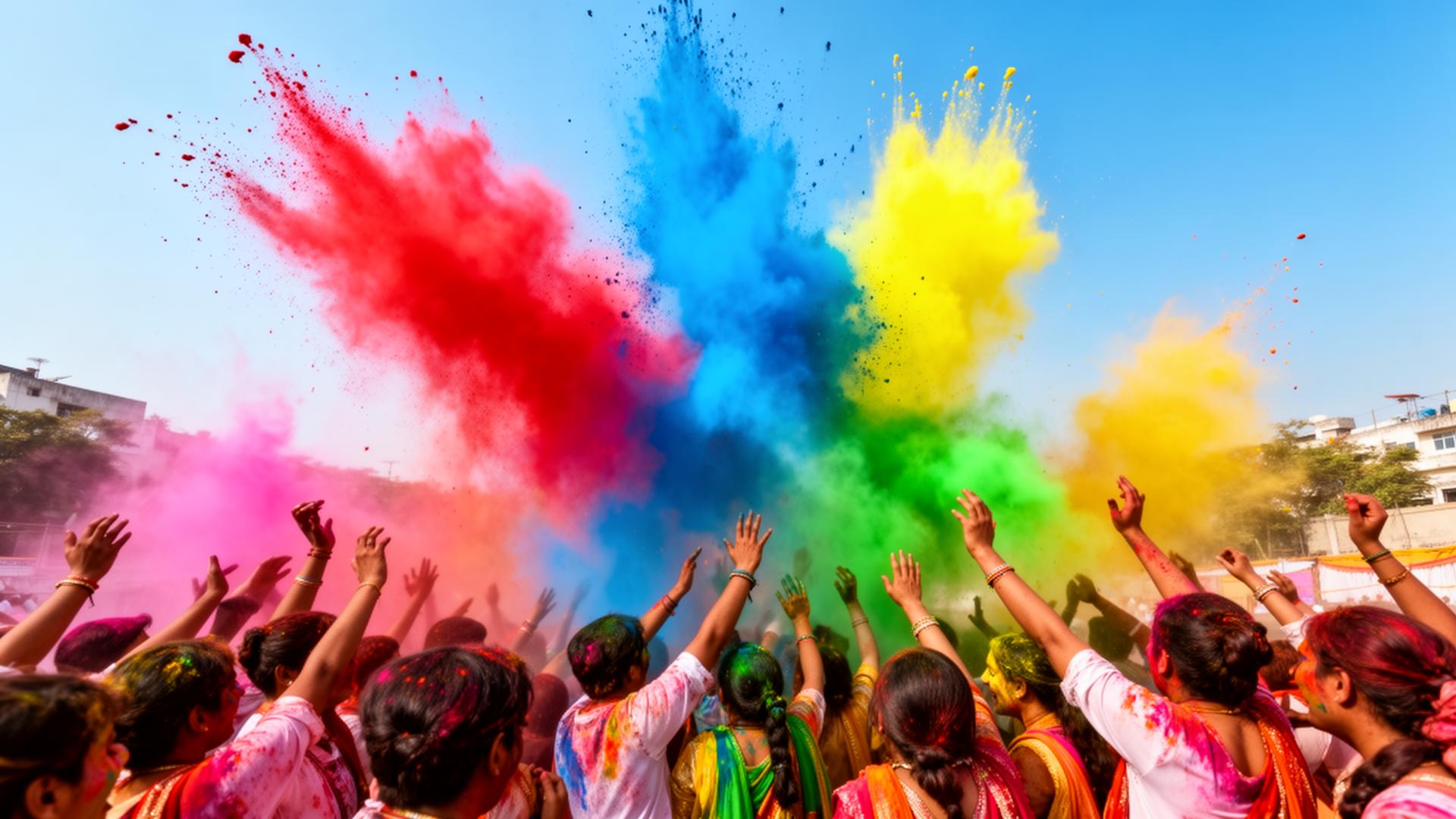
Holi is the world's most chromatic celebration. Every spring, millions of people across India and the global diaspora fill the streets with clouds of colored powder (gulal), transforming cities, villages, and temples into living paintings. But Holi is not random color — every shade thrown during the festival carries centuries of meaning rooted in Hindu mythology, Ayurvedic medicine, seasonal agriculture, and the philosophical framework of Indian culture. Understanding these meanings transforms Holi from a spectacle into a story told in color.
This guide examines the six most significant colors of Holi, traces their mythological and cultural origins, provides exact hex codes for each traditional shade, and explores how the design principles embedded in Holi's palette can inform contemporary creative work.
Red (Lal लाल): Divine Love and Fertility
Red is the supreme color of Holi and the most symbolically potent color in all of Indian culture. During Holi, red powder represents love in its most expansive sense — not merely romantic love, but the divine love (prema) that Hindu philosophy considers the fundamental force of the universe.
Mythological roots: The red of Holi traces directly to the legend of Radha and Krishna. According to tradition, the young god Krishna — whose own skin was blue — was jealous of Radha's fair complexion. His mother Yashoda playfully suggested he color Radha's face with powder. Krishna smeared Radha's cheeks with red gulal, and from this act of divine mischief, the tradition of Holi was born. Red therefore represents the love between Radha and Krishna — a love that transcends physical form and social boundary.
Traditional Holi reds:
- Sindoor Red
#E53935— The warm, slightly orange-leaning red of traditional sindoor (vermillion) powder. This is the definitive Holi red, associated with marriage, devotion, and auspiciousness. Married women apply sindoor to their hair parting as a symbol of their union — during Holi, this sacred red becomes universal. - Kumkum Crimson
#C62828— A deeper, cooler red made from turmeric mixed with lime. This shade appears in temple rituals and formal religious ceremonies during Holi. It carries the weight of sacred ritual rather than playful celebration. - Gulal Rose Red
#EF5350— The lighter, brighter red of commercial gulal powder. This is the red that fills the air during modern Holi celebrations — vivid, joyful, and impossible to ignore.
Cultural significance beyond Holi: Red is the color of the bridal sari, the tilak mark on the forehead, the border of auspicious garments, and the color offered to deities in temples across India. To throw red during Holi is to share the most sacred color in Indian culture — an act of generosity, blessing, and connection.
Blue (Neela नीला): Krishna's Divine Skin
Blue at Holi represents Krishna himself — the god whose skin is depicted in the deep blue of monsoon clouds. Krishna is the central deity of Holi celebrations, and blue powder connects every participant to his divine playfulness. Where red represents love between beings, blue represents the divine presence that makes love possible.
Why Krishna is blue: Hindu mythology offers several explanations. The most widely known tells of the infant Krishna drinking milk from the demoness Putana, whose poisoned breast milk turned his skin permanently blue. In philosophical interpretation, Krishna's blue represents the infinite — the color of the sky and the ocean, suggesting that the divine is as boundless and all-encompassing as the blue expanse above and around us.
Traditional Holi blues:
- Krishna Blue
#1565C0— The rich, saturated blue of Krishna's skin as depicted in classical Indian painting (especially the Rajput and Pahari miniature traditions). This blue is deeper than sky blue but brighter than navy — it carries the quality of dusk, the moment when day becomes night and the ordinary becomes magical. - Neel Indigo
#1A237E— The deep indigo of traditional Indian indigo dye (neel). India was the world's primary source of indigo for millennia, and this deep blue is embedded in the country's textile and artistic heritage. During Holi, deeper blues connect to this artisanal tradition. - Monsoon Blue
#2196F3— A brighter, more contemporary blue that evokes the monsoon clouds that Krishna is compared to in devotional poetry. This lighter shade is common in modern Holi celebrations where commercial powder replaces traditional preparations.
Design insight: Krishna Blue #1565C0 is one of the most versatile and distinctive blues in any cultural palette. It is warmer than corporate blue, deeper than sky blue, and more saturated than dusty blue. For designers seeking a blue that feels culturally rich rather than generically professional, this shade offers immediate depth.
Yellow (Peela पीला): Turmeric, Spring, and Sacred Fire
Yellow is the oldest color of Holi and the one most directly connected to the festival's agricultural and medicinal roots. Traditional Holi powder was made primarily from turmeric (haldi), the golden spice that has served as medicine, dye, preservative, and sacred offering in Indian culture for over 4,000 years.
The turmeric connection: Turmeric is not merely a coloring agent — it is considered one of the most auspicious substances in Hindu culture. It is applied to the bride and groom before weddings (haldi ceremony), mixed into sacred water for purification rituals, and used in Ayurvedic medicine to treat inflammation, wounds, and respiratory conditions. When Holi participants throw yellow powder, they are literally showering each other with a substance their culture considers medicinal and purifying.
Yellow also represents Vishnu. As one of the principal deities of Hinduism, Vishnu is often depicted wearing yellow garments (pitambara). Yellow at Holi therefore carries associations of divine preservation, cosmic order, and the sustaining force of the universe.
Traditional Holi yellows:
- Haldi Gold
#F9A825— The warm, golden yellow of fresh turmeric powder. This is the most authentic Holi yellow — slightly orange-leaning, earthy, and rich. It is the color of turmeric paste applied in rituals and the color that stains fingers, clothes, and surfaces during Holi. - Marigold Yellow
#FFB300— The brilliant orange-yellow of the marigold flower (genda), which is the most common flower offering in Hindu worship. Marigold garlands decorate temples, homes, and vehicles during Holi, making this yellow ubiquitous in the festival landscape. - Basant Yellow
#FDD835— A brighter, cooler yellow named after the Basant Panchami festival that occurs weeks before Holi. Basant celebrates the arrival of spring, and this lighter yellow represents new growth, fresh mustard fields, and the returning warmth of the sun.
Cultural context: The yellow of Holi connects to the mustard fields that bloom across North India during the Holi season (February-March). The landscape itself turns golden, and the festival's yellow powder mirrors the natural world's seasonal transformation. This alignment between cultural celebration and natural cycle is central to Holi's meaning.
Green (Hara हरा): Spring, Renewal, and New Beginnings
Green at Holi represents the triumph of spring over winter — the literal greening of the landscape that the festival celebrates. Holi falls on the full moon of the Hindu month of Phalguna (February-March), precisely when winter's brown gives way to the first flush of new vegetation across the Indian subcontinent.
Agricultural roots: India has been an agricultural civilization for millennia, and Holi's timing coincides with the wheat harvest in North India and the sugarcane harvest in parts of the south. Green represents the abundance of the land, the reliability of the seasons, and the hope that comes with new growth. Throwing green during Holi is an act of gratitude for the earth's productivity and an expression of faith in continued abundance.
Traditional Holi greens:
- Neem Green
#388E3C— Named after the neem tree, whose leaves are used in traditional Holi preparations. Neem is considered purifying in Ayurvedic tradition, and this mid-tone green carries associations of health, purification, and natural medicine. - Mehndi Green
#6D8B3C— The olive-toned green of dried henna (mehndi), another plant deeply embedded in Indian celebration culture. This earthier green connects Holi to the broader tradition of botanical color in Indian life. - Spring Parrot Green
#4CAF50— A brighter, more vivid green that represents the parrots and parakeets associated with spring in Indian poetry. This green is joyful and energetic — the color of nature at its most exuberant.
Spiritual dimension: Green also represents the heart chakra (Anahata) in Hindu-Buddhist tradition — the energy center associated with love, compassion, and emotional healing. Holi's green therefore carries an emotional dimension: it is the color of hearts opening, of compassion expanding, and of emotional renewal that mirrors nature's physical renewal.
Pink (Gulabi गुलाबी): Optimism, Joy, and Playfulness
Pink is the color most associated with the spirit of Holi — the mischief, laughter, and uninhibited joy that make the festival unique among world celebrations. While red carries the weight of divine love and yellow bears the seriousness of sacred tradition, pink is pure playfulness. It is the color of children's laughter, of friends chasing each other through streets, of the moment when all social hierarchies dissolve in a cloud of bright powder.
Traditional Holi pinks:
- Gulal Pink
#EC407A— The signature pink of Holi gulal powder — bright, warm, and irresistibly cheerful. This is the pink that covers faces in every Holi photograph, the color that transforms ordinary streets into celebration spaces. - Rose Pink
#F48FB1— A softer, more romantic pink associated with rose petals, which are scattered during the Holi celebration alongside powder. Rose water (gulab jal) is also sprinkled during more refined Holi gatherings, adding fragrance to color. - Lotus Pink
#E91E63— A deeper, more saturated pink named after the lotus flower, which is the seat of several Hindu deities and a symbol of spiritual enlightenment emerging from material existence.
Pink's modern significance: In contemporary India, pink has taken on additional meaning as a color of social progress. The Pink Gang (Gulabi Gang), a women's rights organization in Uttar Pradesh, chose pink as their color of resistance and empowerment. During Holi, pink therefore carries both traditional joy and contemporary courage — a color that celebrates freedom in all its forms.
Color Symbolism in Indian Culture: Beyond Holi
Holi's palette does not exist in isolation — it is an intensified expression of a color system that permeates every aspect of Indian life. Understanding this broader system illuminates the depth of Holi's chromatic language.
The sacred color hierarchy: Indian culture assigns colors to deities, directions, elements, and life stages. White belongs to Saraswati (knowledge) and Shiva (destruction/renewal). Saffron #FF6F00 represents renunciation and spiritual seeking — it is the color of sannyasi robes and the top stripe of the Indian flag. Maroon #800000 belongs to the earth and material wealth.
Color and caste: Historically, certain colors were restricted to specific social groups. Holi's revolutionary significance lies partly in its dissolution of these restrictions — during Holi, everyone wears every color, and the boundaries that color enforces during ordinary life are temporarily erased. The festival is, in chromatic terms, an act of radical equality.
Rangoli and kolam: The tradition of creating geometric floor designs from colored powder (rangoli in North India, kolam in South India) connects directly to Holi's use of colored powder. These daily designs, created at doorsteps each morning, use the same pigments as Holi gulal — turmeric yellow, sindoor red, rice flour white — maintaining the sacred color vocabulary in everyday domestic practice.
The Navratri connection: Each of the nine nights of Navratri is associated with a specific color, creating a chromatic calendar for worship. This system — where each day carries a color meaning — reflects the same principle that makes Holi's colors meaningful rather than arbitrary.
Practical Tips: Designing with Holi-Inspired Palettes
Use the full spectrum intentionally. The Holi palette is one of the few cultural palettes that successfully incorporates the entire color wheel. Build a palette using all six Holi colors —
#E53935red,#1565C0blue,#F9A825yellow,#388E3Cgreen,#EC407Apink — but assign each a clear role. Use the 60-30-10 rule with one dominant, one secondary, and the rest as accents.Embrace saturation. Indian color aesthetics differ fundamentally from Western minimalism. Where Western design often mutes and restrains color, Indian design celebrates full saturation. If you are drawing from Holi, commit to vivid values —
#E53935rather than#FFCDD2,#1565C0rather than#90CAF9. Half measures lose the energy that makes this palette powerful.Pair vibrant colors with warm neutrals. The architecture of Indian celebration spaces — sandstone walls, terracotta floors, whitewashed surfaces — provides a warm neutral backdrop that makes vivid colors sing rather than clash. Use
#F5F0E8(warm off-white) or#D7CEC7(warm stone) as your background, not cool gray.Consider powder texture. Holi colors appear in the world as clouds, dusts, and granular surfaces — not as flat digital fills. When designing with Holi-inspired palettes, add texture: grain overlays, gradient diffusion, and soft edges that evoke the physical quality of thrown powder.
Respect the cultural source. Holi's colors carry deep spiritual and cultural meaning. When using this palette for commercial design, acknowledge the tradition. Avoid reducing Holi to a "fun color explosion" — the festival is a religious and cultural event with significance far beyond its visual spectacle.
The colors of Holi teach us that color is never neutral — it is always carrying meaning, history, and intention. Every handful of powder thrown during the festival is simultaneously a physical substance and a cultural statement: about love, divinity, medicine, agriculture, social equality, and the eternal return of spring. For designers, Holi offers the most vivid proof that understanding color's meaning is as important as understanding its aesthetics.