Fibonacci Fun Facts: The Mathematical Sequence Hiding in Plain Sight
· Dr. Marcus Chen
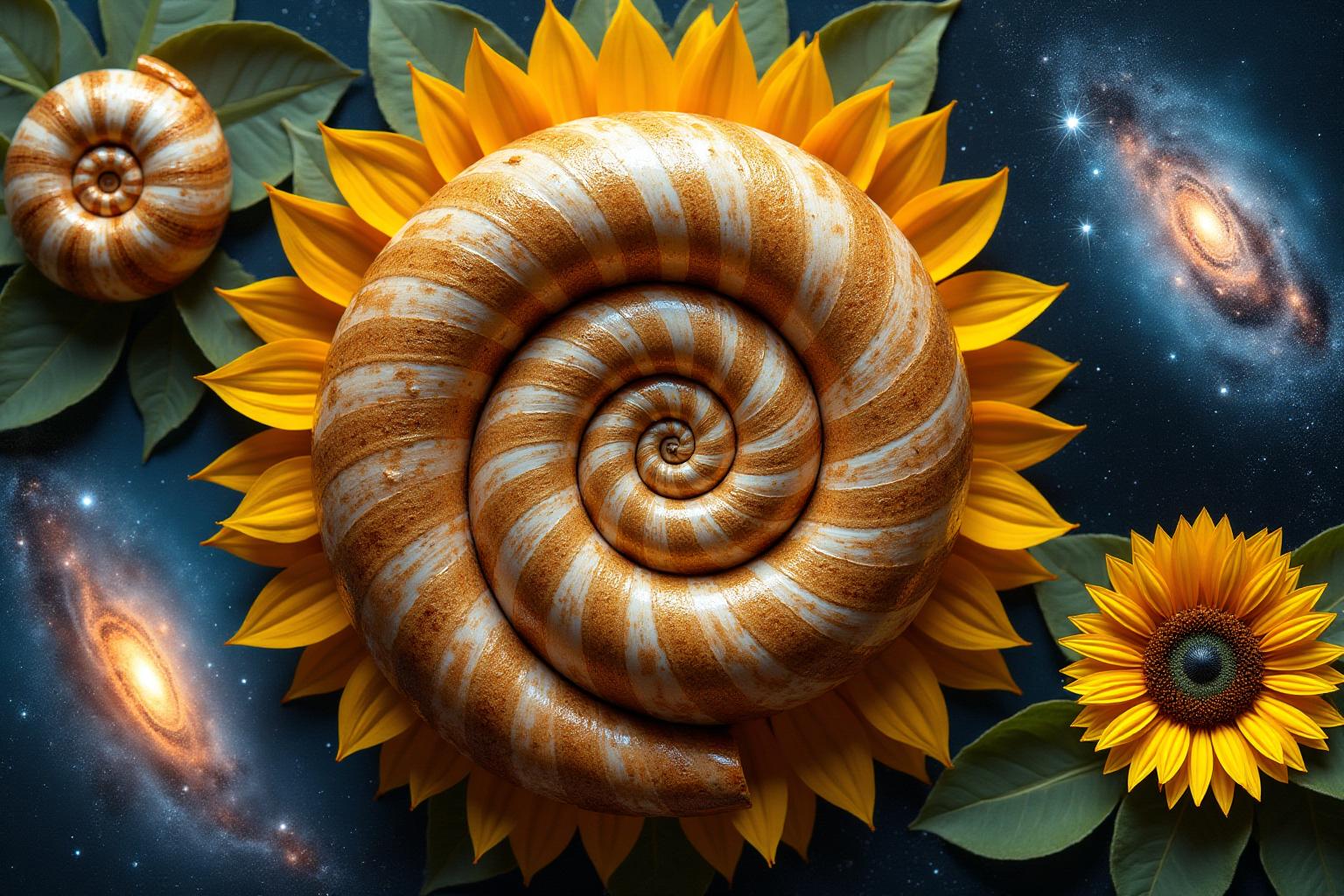
The Mathematical Sequence That's Everywhere You Look
It's 3 PM on a Tuesday afternoon at a Brooklyn grocery store. Dr. Sarah Rodriguez, a mathematics professor at NYU, stands frozen in the produce section, staring at a pineapple. Her colleague, waiting by the shopping cart, finally asks what's wrong.
"Nothing's wrong," she replies, slowly rotating the fruit. "I'm just counting spirals. Eight going one direction, thirteen the other. Classic Fibonacci."
Her colleague laughs, but Dr. Rodriguez is serious. "Once you know what to look for," she explains, "you can't unsee it. The entire universe seems to be written in this sequence."
She's not exaggerating. The Fibonacci sequence—that deceptively simple series of numbers where each is the sum of the two preceding ones—appears in contexts so diverse and unexpected that it seems almost impossible to be coincidence. From the architecture of ancient Greece to the branching of trees, from stock market algorithms to the songs of pop legends, Fibonacci is everywhere.
The Rabbit Problem That Changed Mathematics
The story begins in 1202, when Italian mathematician Leonardo Fibonacci (born Leonardo Pisano) posed what seemed like a simple puzzle in his book Liber Abaci: Suppose a pair of rabbits is placed in an enclosed space. If every month each pair produces a new pair that becomes productive after one month, how many pairs will there be after a year?
The answer—a sequence beginning 1, 1, 2, 3, 5, 8, 13, 21, 34, 55, 89, 144—initially seemed like just an elegant mathematical curiosity. No one, least of all Fibonacci himself, realized he'd stumbled upon something fundamental to the structure of reality itself.
What makes the sequence special isn't just the numbers themselves but their relationship. Divide any Fibonacci number by its predecessor, and as you move further up the sequence, you approach an extraordinary constant: approximately 1.618033988749... This is phi (φ), the golden ratio, and it's been quietly shaping aesthetics, architecture, and natural growth for billions of years.
"It's the most irrational of all irrational numbers," explains Dr. Rodriguez. "It can't be expressed as a fraction, and its decimal expansion never repeats. Yet somehow, nature 'prefers' this number when determining growth patterns."
Nature's Secret Blueprint
The most striking Fibonacci examples come from the natural world, where the sequence appears with almost eerie consistency:
Sunflowers hold mathematical records. Count the spirals in a sunflower's seed arrangement, and you'll invariably find Fibonacci numbers: 21 spirals in one direction, 34 in the other. Larger sunflowers display 55 and 89, or even 89 and 144. In 2016, a specimen was documented with 144 and 233 spirals—both Fibonacci numbers.
Why? The answer lies in optimal packing. As a sunflower grows, it produces seeds from the center outward. Each seed is positioned at an angle determined by the golden ratio (approximately 137.5 degrees—the "golden angle"). This arrangement maximizes the number of seeds that can fit in the available space without leaving gaps. Evolution has, in effect, discovered calculus.
Your body is a Fibonacci showcase. Hold up your hand and look carefully. The ratio of the bone lengths in your fingers follows Fibonacci proportions. Your forearm compared to your hand? Fibonacci. The distance from your shoulder to your fingertips compared to your elbow to your fingertips? Fibonacci again.
The human face displays similar proportions. The distance from the top of your head to your chin compared to your chin to your navel, compared to your navel to your feet—all approximate the golden ratio. Even the spiral of your inner ear follows this pattern.
DNA itself is built on these numbers. A DNA molecule measures 34 angstroms long by 21 angstroms wide for a complete spiral—both Fibonacci numbers. The double helix completes a full turn every 34 angstroms, and each of these turns contains exactly 10 base pairs, which relates back to Fibonacci through the golden angle.
"It's not that DNA 'chose' these proportions," clarifies Dr. James Wu, a biophysicist at Stanford. "It's that these proportions represent the most stable configuration given the chemical constraints. Fibonacci appears in nature not by design but because these ratios represent optimal solutions to physical problems."
Shells and spirals tell the same story. The nautilus shell is perhaps the most iconic example—as the creature grows, it adds chambers in a spiral that expands according to the golden ratio. But it's far from alone. Hurricane formations, galaxies, the cochlea of your inner ear, even the curve of ocean waves—all follow logarithmic spirals based on Fibonacci proportions.
Pine cones display spirals in both directions, typically showing 8 spirals one way and 13 the other. Pinecones from different species might show 5 and 8, or 13 and 21, but always Fibonacci pairs. The same pattern appears in pineapples, artichokes, and cauliflower.
Plants branch according to the sequence. Count the branches on a tree as you move up the trunk, and you'll often find Fibonacci numbers. Many flowers have 3 petals (lily, iris), 5 petals (buttercup, wild rose), 8 petals (delphiniums), 13 petals (ragwort, corn marigold), 21 petals (aster, chicory), 34 petals (plantain, pyrethrum), or 55/89 petals (michaelmas daisies, asteraceae family).
Why? Again, it comes down to optimal spacing. Leaves arranged according to Fibonacci angles maximize each leaf's exposure to sunlight and rain while minimizing overlap with other leaves. This arrangement is so efficient that the vast majority of plants have evolved to use it.
Hidden in Plain Sight: Everyday Fibonacci
Beyond nature, the sequence appears in surprising places throughout daily life:
Piano keyboards tell a Fibonacci story. An octave on a piano comprises 13 keys: 8 white and 5 black, arranged in groups of 2 and 3. Every single one of those numbers—2, 3, 5, 8, 13—is a Fibonacci number. This isn't a coincidence; the arrangement emerged from mathematical principles of harmony that composer and music theorists developed centuries ago, unknowingly based on these proportions.
Your credit cards hide the ratio. Most credit cards measure 85.60mm by 53.98mm, which gives a ratio of approximately 1.586—remarkably close to the golden ratio. The standard was set by banking authorities partly because this proportion "feels right" when held, which is precisely why it feels right: our brains are attuned to golden ratio proportions.
Architecture throughout history embraces phi. The Parthenon in Athens, constructed in 447-432 BCE, incorporates the golden ratio in its façade dimensions—the height to width ratio of the entire structure, and again in the columns themselves. The Great Pyramid of Giza, built around 2560 BCE, has a ratio of height to half the base perimeter that approximates phi with remarkable accuracy.
Was this intentional? Historians debate this. Some argue ancient architects explicitly knew and used these proportions. Others suggest they arrived at them intuitively, guided by what "looked right"—which itself reflects the human tendency to prefer golden ratio proportions.
Art, Music, and Culture
Leonardo da Vinci was a Fibonacci master. His famous Vitruvian Man drawing demonstrates ideal human proportions—proportions that approximate the golden ratio. In the Mona Lisa, da Vinci used golden rectangles to position her face and body. The portrait itself fits into a golden rectangle, and her face fits into a smaller one nested within.
Da Vinci wasn't alone. Renaissance painters regularly used the golden ratio to create compositions that felt balanced and pleasing. They called it "divine proportion," believing it reflected God's design of the universe.
Classical composers used Fibonacci structures. Béla Bartók deliberately composed several pieces with measures divided according to Fibonacci numbers. His Music for Strings, Percussion, and Celesta has its climax at exactly measure 55 (a Fibonacci number) of an 89-measure movement (also Fibonacci).
Claude Debussy's Reflets dans l'eau shows similar structure, with phrase lengths and harmonic changes often occurring at Fibonacci measure numbers. Whether this was conscious mathematical planning or intuitive musical sense remains debated, but the presence of the pattern is undeniable.
Pop culture has embraced the sequence. The 2006 Dan Brown novel The Da Vinci Code features the Fibonacci sequence prominently in its plot. The 1998 film Pi revolves around a mathematician's obsession with finding patterns in numbers, including Fibonacci sequences. Even The Simpsons has featured multiple Fibonacci jokes and visual references.
More surprisingly, the Tool song "Lateralus" has syllables per verse that follow the Fibonacci sequence: 1, 1, 2, 3, 5, 8, 5, 3, 2, 1, 1. The band's vocalist, Maynard James Keenan, studied art before music and deliberately incorporated the mathematical structure.
Mind-Bending Mathematical Properties
The Fibonacci sequence has bizarre and beautiful mathematical properties that continue to fascinate researchers:
Divisibility patterns are perfect. Every 10th Fibonacci number is divisible by 11. Every 12th is divisible by 144. Every 15th is divisible by 610. This perfect regularity seems almost designed, though it emerges naturally from the sequence's recursive definition.
Squares create more Fibonacci numbers. Take any Fibonacci number, square it, and compare it to the product of its neighbors. The difference is always 1 or -1. For example: 5² = 25, while 3 × 8 = 24. Or 8² = 64, while 5 × 13 = 65. This property, known as Cassini's identity, has been known since 1680.
Sums reveal hidden patterns. Add the first ten Fibonacci numbers (1+1+2+3+5+8+13+21+34+55 = 143), and you get exactly one less than the eleventh Fibonacci number (144). This works for any sequence length: the sum of the first n Fibonacci numbers equals the (n+2)th Fibonacci number minus 1.
It connects to Pascal's Triangle. If you sum the numbers along the diagonals of Pascal's Triangle, you get Fibonacci numbers. This beautiful connection links three seemingly unrelated areas of mathematics: sequences, binomial coefficients, and combinatorics.
The ratio of consecutive terms converges. As mentioned earlier, dividing each Fibonacci number by its predecessor approaches phi. But the approach itself follows a pattern: the ratios alternately exceed and fall short of phi, converging in a spiral pattern that itself reflects the golden spiral.
Modern Applications
Far from being mathematical curiosities, Fibonacci numbers have practical modern applications:
Computer algorithms use Fibonacci search. When searching sorted data, Fibonacci search algorithms can be more efficient than binary search for certain types of data structures. The method divides the search space according to Fibonacci numbers, taking advantage of the sequence's properties.
Financial markets show Fibonacci patterns. Technical traders use "Fibonacci retracements" to predict potential reversal points in stock prices. While controversial among academics, many traders swear by Fibonacci levels (23.6%, 38.2%, 61.8%) as key support and resistance points. Whether markets actually follow these patterns or traders create them by believing in them remains hotly debated.
UX/UI designers apply the golden ratio. Web designers and app developers use Fibonacci-based proportions to create layouts. Twitter's interface redesign famously used golden ratio proportions. The size ratio of sidebars to main content areas, the spacing between elements, even the dimensions of profile pictures often approximate these proportions.
"It's about creating interfaces that feel right," explains Amanda Foster, a senior UX designer at a major tech company. "When spacing and proportions follow the golden ratio, users can't necessarily articulate why, but they report that things 'just work' better."
Cryptography employs Fibonacci properties. Some encryption algorithms use Fibonacci numbers in their mathematical operations. The sequence's predictable yet complex properties make it useful for certain types of pseudo-random number generation.
The Bee Connection
One of the most surprising Fibonacci appearances involves family trees—specifically, bee family trees.
In honeybee colonies, females (worker bees and queens) develop from fertilized eggs and therefore have both a mother and a father. Males (drones) develop from unfertilized eggs and have only a mother. This quirk of bee reproduction creates a fascinating pattern:
A male bee has 1 parent (mother), 2 grandparents (maternal grandmother and grandfather), 3 great-grandparents, 5 great-great-grandparents, 8 great-great-great-grandparents—the Fibonacci sequence exactly.
"It's one of those facts that makes you do a double-take," says Dr. Rodriguez. "Here's this sequence emerging from pure logic of reproduction, with no apparent 'purpose' behind it. Yet there it is, perfect and undeniable."
Questions Without Answers
Despite centuries of study, some mysteries about Fibonacci remain:
Why does nature prefer these numbers? We understand the optimization argument—that golden angle spirals pack seeds efficiently, that Fibonacci branching maximizes light exposure. But why these specific numbers? Why not some other ratio that's close but different?
"The honest answer is we don't fully know," admits Dr. Rodriguez. "We can describe what happens and show that these patterns are efficient. But whether there's some deeper principle—some fundamental law of physics or mathematics that makes phi inevitable—remains an open question."
Are there patterns we haven't found yet? Given how frequently Fibonacci appears in unexpected places, mathematicians wonder what else might be hiding. Could biological processes we don't yet understand involve Fibonacci? Could there be cosmic patterns at scales we can't yet measure?
Why do our brains find it beautiful? Multiple studies show that humans, across cultures, tend to prefer golden ratio proportions in art, architecture, and even faces. But is this preference learned—a result of exposure to these proportions throughout nature and culture? Or is there something hardwired in our visual processing that responds to these mathematical relationships?
Try It Yourself
The beauty of Fibonacci is that once you know what to look for, you can't stop finding it. Here are some everyday examples to check:
- Count petals on flowers in your garden or local park
- Measure the sections of your fingers with a ruler
- Examine pine cones, pineapples, or artichokes for spiral patterns
- Look at famous buildings and paintings for golden rectangles
- Listen to classical music and track when themes repeat or change
- Observe how tree branches emerge from the trunk
As Dr. Rodriguez noted in that Brooklyn grocery store, once you start seeing Fibonacci, you see it everywhere. The sequence becomes a kind of secret language—a mathematical poetry underlying reality itself.
The Deeper Meaning
Perhaps the most profound aspect of Fibonacci isn't its ubiquity but what that ubiquity suggests about the nature of reality itself.
"Mathematics," Dr. Rodriguez muses, "isn't something humans invented to describe the world. It's something we discovered that the world already was using. The Fibonacci sequence was encoding optimal growth patterns billions of years before humans existed to notice it."
This realization has philosophical implications. If mathematical principles like Fibonacci govern everything from galaxy formation to flower petals, then mathematics isn't just a human tool—it's the fundamental language of existence.
The sequence reminds us that beneath the chaotic surface of reality lies deep order, that pattern and proportion govern growth and structure at every scale. From the microscopic spiral of DNA to the cosmic spiral of galaxies, from the arrangement of a simple flower's petals to the most sophisticated architecture, the same ratio appears again and again.
It's a reminder that despite how random and unpredictable the world might seem, there are principles—beautiful, elegant, mathematical principles—at work everywhere. Once you know how to look, you can see them hiding in plain sight, written in the ancient language of numbers, whispering the secrets of how the universe builds itself.
And all of it traceable back to a 13th-century mathematician pondering a question about rabbits.