National Flag Colors Decoded: Hex Codes & Psychology of 12 Iconic Country Flags
· Coloracci Editorial
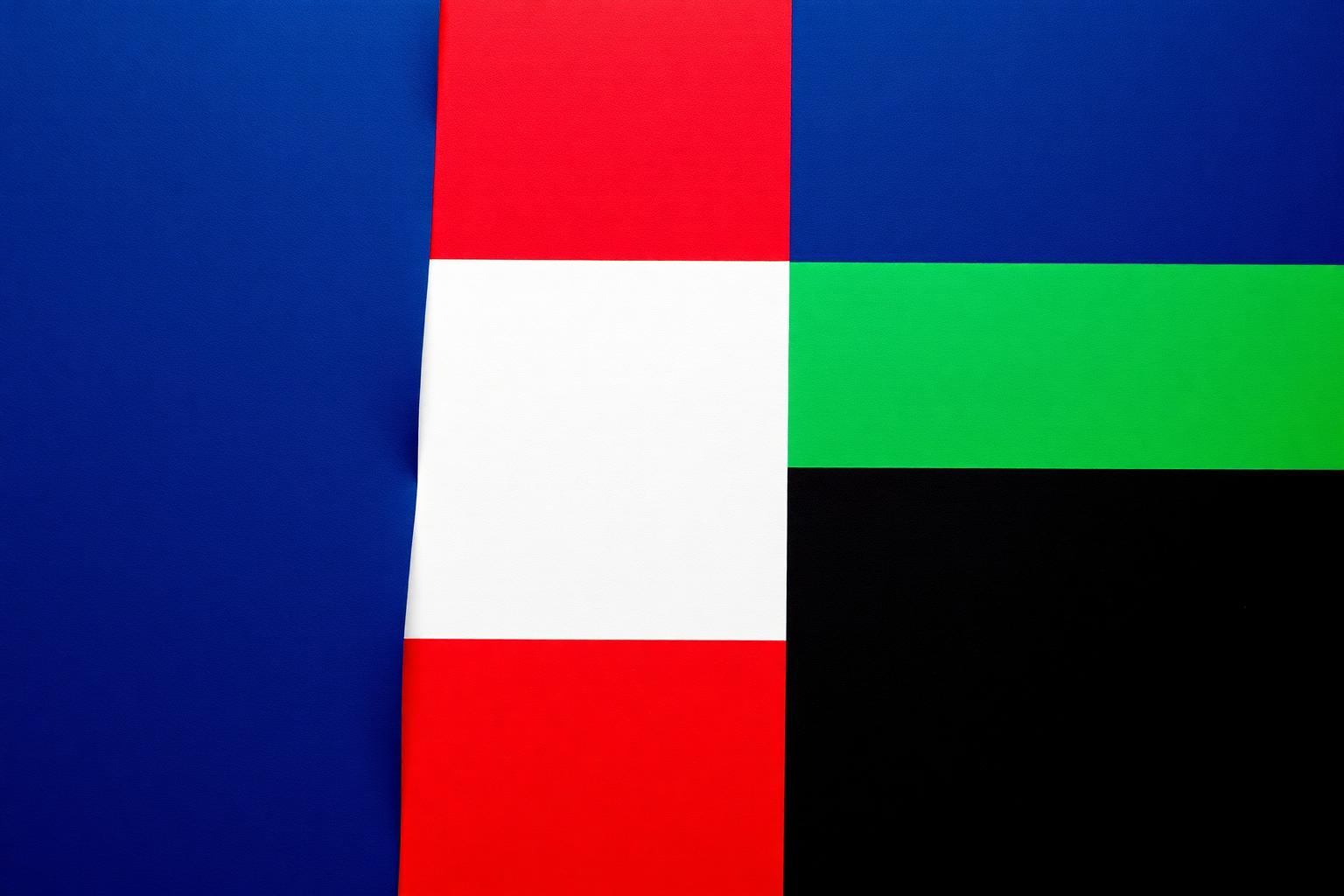
For designers, brand strategists, and color enthusiasts, national flag colors are the original case study in symbolic design. A flag must communicate identity, values, and emotion in a single glance — from a stadium to a satellite — using just two to four hues. Every shade is deliberate, every contrast ratio engineered, every cultural reference loaded with centuries of meaning.
This guide is a working reference. We break down the exact national flag colors — with verified hex codes, official color names, and psychological associations — for 12 of the world's most recognized flags. Then we extract the patterns, decode the symbolism, and translate it into actionable lessons you can apply to brand systems, product UI, and editorial design.
If you want the higher-level global overview (color frequency across 195 nations, regional palettes, the absence of purple), see our companion piece on flag colors around the world. This article goes deep on the country-level specifics.
Why National Flag Colors Matter to Designers
A national flag is a constrained brand system operating under the harshest conditions imaginable: it must remain legible at 500 meters, recognizable at 5 centimeters, reproducible on cotton, silk, pixels, and paint, and meaningful across generations and cultures. Almost no commercial brand operates under that brief.
That constraint is exactly why flag palettes are such a powerful study. The designers behind these systems — often anonymous committees over decades — converged on a small set of principles that modern design teams rediscover the hard way:
- Limit the palette. Most flags use 2–4 colors. No exceptions for "brand seasonal accents."
- Maximize contrast. Red on white. Blue on gold. Black on yellow. No mid-tones competing for attention.
- Assign one job per color. Every hue carries a defined symbolic role — never decorative.
- Engineer for scale. The same palette must work on a lapel pin and a building.
These are the same principles behind every great brand system, from Google's four-color logo to the color psychology of superhero suits.
The Complete Breakdown: 12 National Flag Colors with Exact Hex Codes
Below is a country-by-country reference. Hex codes are sourced from official government style guides and the Jootoor and Color Experts BD flag color databases. Color names follow standard heraldic and vexillological conventions where applicable.
🇺🇸 United States
The Stars and Stripes uses a deeply saturated tricolor calibrated for high-contrast visibility against any sky.
- American Blue —
#3C3B6E— Loyalty, perseverance, justice - American Red —
#B22234— Valor, bravery, the blood of patriots - White —
#FFFFFF— Purity, innocence
The American blue is unusually dark — closer to navy than royal — giving the canton its weight and historical gravitas. The red is muted compared to other national reds, intentionally avoiding the aggression of pure scarlet.
🇨🇦 Canada
A masterclass in two-color minimalism, the Canadian flag is arguably the most legible national flag ever designed.
- Canadian Red —
#D52B1E— Hope, prosperity, charity - White —
#FFFFFF— Peace, tranquility, neutrality
The 1:2:1 proportional split (red-white-red) creates an inherent golden-ratio rhythm, while the centered maple leaf functions as a perfect focal accent.
🇷🇺 Russia
The Russian tricolor's symbolism predates the modern state, drawing on Pan-Slavic color traditions.
- White —
#FFFFFF— Nobility, frankness - Pan-Slavic Blue —
#0039A6— Loyalty, honesty, chastity - Russian Red —
#D00B0E— Courage, self-sacrifice, generosity, love
This palette inspired dozens of Slavic flags, making it one of the most influential color systems in vexillology.
🇩🇪 Germany
Black, red, and gold trace back to 19th-century German nationalism and remain among the most ideologically loaded color choices in Europe.
- Black —
#000000— Determination, revolution, the dark past overcome - Red —
#FF0000— Valor, the blood of those who fought for unity - Gold —
#FFCC00— Generosity, prosperity, a golden future
The horizontal sequence — darkness, struggle, hope — reads as a narrative arc.
🇬🇧 United Kingdom
The Union Jack layers three crosses (St. George, St. Andrew, St. Patrick) into a single dense composition.
- Union Blue —
#012169— Vigilance, perseverance, justice - British Red —
#C8102E— Hardiness, valor, bravery - White —
#FFFFFF— Purity, innocence
The deep navy (#012169) is one of the most copied flag colors in the world — adopted by Australia, New Zealand, Fiji, and Tuvalu in their canton designs.
🇫🇷 France
The original revolutionary tricolor, France's flag established the visual template for liberation movements worldwide.
- French Blue —
#0055A4— Revolution, liberty, the bourgeoisie of Paris - White —
#FFFFFF— Peace, purity, the monarchy - French Red —
#EF4135— Bravery, valor, the blood of revolution
Note the brighter, more orange-leaning red compared to American or British flags — a Mediterranean palette tuned for vivid sun.
🇨🇭 Switzerland
One of only two square national flags (the other being Vatican City), Switzerland's design is brutally simple.
- Swiss Red —
#FF0000— Sovereignty, strength, neutrality with force - White —
#FFFFFF— Purity, peace, the cross of Christianity
Pure RGB red on pure white achieves maximum possible chromatic contrast — a deliberate choice for a nation defined by clarity.
🇸🇦 Saudi Arabia
The only national flag featuring text (the Shahada), Saudi Arabia's design is religiously specific.
- Islamic Green —
#006C35— Islam, prosperity, paradise - White —
#FFFFFF— Purity, peace, the sacred inscription
Green's prominence reflects the color's revered status in Islamic tradition, said to have been the Prophet Muhammad's favored color.
🇦🇪 United Arab Emirates
The UAE flag adopts the four Pan-Arab colors — a deliberate gesture of regional solidarity.
- Red —
#FF0000— Courage, strength, unity - White —
#FFFFFF— Peace, honesty, purity - Green —
#00843D— Prosperity, love, hope - Black —
#000000— Defeating enemies, strength of mind
This four-color system traces back to the Arab Revolt of 1916 and appears across the region.
🇨🇳 China
The People's Republic flag is one of the most chromatically reductive national designs — just two hues, both highly saturated.
- Chinese Red —
#DE2810— Revolution, communism, the Chinese spirit - Imperial Gold —
#FFDE00— The Chinese people, prosperity, brightness
Red is also deeply auspicious in traditional Chinese culture — meaning the flag works simultaneously as political symbol and cultural affirmation.
🇯🇵 Japan
The Hinomaru ("circle of the sun") is arguably the most minimalist national flag in existence.
- White —
#FFFFFF— Purity, honesty, the people - Crimson Red —
#BC002D— The sun, passion, integrity
A single saturated red disc on pure white. There is no design more confident in its restraint.
🇰🇷 South Korea
The Taegukgi encodes a complete philosophical system rooted in Confucian and Taoist cosmology.
- White —
#FFFFFF— Peace, purity, the Korean people - Cosmic Blue —
#0047A0— Negative cosmic forces (eum / yin) - Cosmic Red —
#CD2E3A— Positive cosmic forces (yang) - Black —
#000000— Vigilance, justice, the four trigrams
The blue-red Taeguk circle represents universal balance — a visual codification of Taoist duality unmatched in any other national flag.
Patterns & Analysis: What These Color Choices Reveal
Looking across all 12 flags, four structural patterns emerge.
1. Red dominates as the universal carrier of sacrifice
Every flag in this study except Saudi Arabia includes red. Across cultures — American valor, French revolution, Chinese communism, Korean cosmic force — red consistently carries the heaviest semantic load. It is the color humans most readily associate with blood, fire, and emotional urgency, and flag designers have leveraged that for centuries.
2. White is the universal mediator
Ten of twelve flags use white as a structural element. It functions as a "color rest" — a neutral that lets adjacent saturated hues breathe and read clearly at distance. This is the same principle behind whitespace in editorial design.
3. Blues are nation-specific, never interchangeable
American Blue (#3C3B6E) is wholly different from French Blue (#0055A4), Union Blue (#012169), or Russian Blue (#0039A6). Each nation chose a precise shade encoding specific historical context. Lesson: "blue" is not a brand color. The exact hex is.
4. The four most-used hues form a closed system
Red, white, blue, green, gold, and black account for nearly every pixel in national flags worldwide. Designers converged on this set because it offers maximum perceptual contrast across daylight conditions while remaining manufacturable in any era's dye technology.
Color Psychology: What These National Flag Colors Communicate
The psychological signaling across national flag colors maps cleanly to broader color psychology in branding — because flags were the first global brand systems.
- Red activates the sympathetic nervous system. Heart rate increases, attention sharpens. Nations chose red for the same reason fire alarms and emergency vehicles use it: it cannot be ignored.
- Blue lowers physiological arousal, signaling trust, stability, and order. It's why blue dominates institutional design from the UN to LinkedIn.
- Green carries the most culturally variable meaning. In the West it signals nature and growth; across the Islamic world it carries sacred weight; in Pan-African flags it represents fertile land.
- White universally signals purity and surrender — the same color flown to request truce since antiquity.
- Black carries weight: strength, resistance, mourning, authority. It rarely appears alone; instead it anchors other colors and adds visual gravity.
- Gold signals prestige, wealth, and the sun. It's the only color that historically required physical gold thread or expensive ochres to produce — its presence on a flag was once a literal display of resources.
For a deeper psychological analysis of single hues, our superhero color psychology guide breaks down how Marvel and DC apply identical principles to costume design.
Designer Takeaways: How to Apply National Flag Color Logic
These five principles translate directly into modern brand and product design.
1. Pick a "national palette" of 3 hues, then commit
Audit your brand and identify the three colors that carry your meaning — a dominant, a secondary, and an accent. Resist the urge to add a fourth. The clarity of national flags comes from their refusal to expand the palette.
2. Specify exact hex codes — not color names
"Navy blue" is meaningless. #012169 is a contract. National flag designers have known this for centuries; brand teams often forget it. Document the exact RGB, HEX, and Pantone equivalents in your style guide and treat any drift as a defect.
3. Engineer for the worst-case viewing condition
National flags are designed to read in fog, glare, and motion. Your interface is being viewed on a cracked phone screen at noon. Test your palette against WCAG accessibility standards and on low-quality displays before approving it.
4. Pair high-saturation with neutral mediators
Look at how Japan, Switzerland, and Canada use white between saturated hues. The neutral isn't decorative — it's a structural element that lets each color reach maximum impact. Apply the same logic to UI: pure brand color, surrounded by neutral, beats brand color crowded by competing accents every time.
5. Encode meaning into every color choice
Don't pick colors because they "look nice." National flag designers spent decades arguing over symbolism. You should be able to defend every hex code in your palette with a sentence about what it represents and why it's there. If you can't, it shouldn't be there.
Data Table: National Flag Colors Reference
| Country | Primary Color | Hex Code | Color Name | Psychological Meaning |
|---|---|---|---|---|
| United States | Blue | #3C3B6E |
American Blue | Loyalty, perseverance, justice |
| United States | Red | #B22234 |
American Red | Valor, bravery |
| Canada | Red | #D52B1E |
Canadian Red | Hope, prosperity, charity |
| Russia | Blue | #0039A6 |
Pan-Slavic Blue | Loyalty, honesty, chastity |
| Russia | Red | #D00B0E |
Russian Red | Courage, self-sacrifice, love |
| Germany | Black | #000000 |
Black | Determination, revolution |
| Germany | Red | #FF0000 |
Red | Valor, bravery |
| Germany | Gold | #FFCC00 |
Gold | Generosity, prosperity |
| United Kingdom | Blue | #012169 |
Union Blue | Vigilance, perseverance, justice |
| United Kingdom | Red | #C8102E |
British Red | Hardiness, valor, bravery |
| France | Blue | #0055A4 |
French Blue | Revolution, liberty |
| France | Red | #EF4135 |
French Red | Bravery, valor |
| Switzerland | Red | #FF0000 |
Swiss Red | Sovereignty, strength |
| Saudi Arabia | Green | #006C35 |
Islamic Green | Islam, prosperity |
| UAE | Red | #FF0000 |
Red | Courage, strength, unity |
| UAE | Green | #00843D |
Green | Prosperity, love, hope |
| UAE | Black | #000000 |
Black | Defeating enemies, strength |
| China | Red | #DE2810 |
Chinese Red | Revolution, the Chinese spirit |
| China | Gold | #FFDE00 |
Imperial Gold | Chinese people, prosperity |
| Japan | Red | #BC002D |
Crimson | The sun, passion, integrity |
| South Korea | Blue | #0047A0 |
Cosmic Blue | Negative cosmic forces (eum) |
| South Korea | Red | #CD2E3A |
Cosmic Red | Positive cosmic forces (yang) |
| South Korea | Black | #000000 |
Black | Vigilance, justice |
Conclusion: Build Your Own National-Grade Palette
National flag colors endure because they are engineered. Every hex code carries history, every contrast pairing is intentional, every omission is deliberate. The best modern brand systems — Google, Coca-Cola, Netflix, Nike — operate on the same principles flag designers worked out centuries ago.
If you're building a brand palette, product UI, or editorial system, treat your colors with the same seriousness. Pick fewer hues. Specify exact values. Defend every choice. Engineer for contrast first, aesthetic second.
Ready to design a palette with the precision of a national flag? Try the Coloracci Fibonacci palette generator — feed any hex code (like #012169 or #BC002D) as a seed and let the algorithm build a mathematically balanced palette around it, applying the same proportional discipline that makes great flags unforgettable.
Explore more brand and palette analysis at coloracci.ai, or dive into our companion piece on color frequency across national flags worldwide.
Sources: Jootoor Flag Color Database, Color Experts BD Hex Codes Guide, Kengla World Flags Meanings, eLearn College Flag Colour Meaning, 2026.